- Sovereignty Education and Defense Ministry (SEDM) (OFFSITE LINK)-ministry which teaches people how to be sovereign
- Sovereignty Forms and Instructions Online-free! Provides useful tools and techniques on how to become "foreign" and "sovereign" with respect to government jurisdiction
- Sovereignty Forms and Instruction Manual, Form #10.005 (OFFSITE LINK)-downloadable PDF version of the above
- Sovereignty-Rousas John Rushdoony. Theological perspective on sovereignty.
- The Sovereignty of God and Civil Government, Pastor John Weaver, Item #1.16 (OFFSITE LINK)-Sovereignty Education and Defense Ministry
- Reflections on the Sovereignty of God (OFFSITE LINK)- Nike Insights
- Are You an Idiot? (OFFSITE LINK) -all foreigners and people who are sovereign are "idiots"
- Jesus, The Great Divider (OFFSITE LINK)-Nike Insights
- Nazirite (OFFSITE LINK) - a person sanctified and separated from the world for the service of God. Today from a legal perspective, this would be called a "non-resident non-person" or "civilly dead".
- Essenes: Gnostic Illuminati Masons or Early Christians? (OFFSITE LINK) - David H'Notsari
 Policy Document: Rebutted False Arguments About Sovereignty, Form #08.018 (OFFSITE LINK) -rebuts false propaganda about sovereignty spread by corrupted governments and the legal profession
- Policy Document: Answers to Press Questions About Sovereignty Advocacy, Form #08.019 (OFFSITE LINK) -common press questions about sovereignty answered
- Authorities on "sovereignty" -Sovereignty Forms and Instructions Online, Form #10.004, Cites by Topic
- Hierarchy of Sovereignty: The Power to Tax is the Power to Create-Defines all the rules for sovereignty in the law. Very intresting
- Sovereignty and Freedom Page -legal research on how to become sovereign. By Family Guardian Fellowship
- Disclaimer Page, Section 4: Definition of "sovereign" - defines EXACTLY what we mean on this website when we invoke the term "sovereign"
- Why Domicile and Becoming a "Taxpayer" Require Your Consent, Form #05.002 (OFFSITE LINK)-excellent article that describes those with no domicile in a government as "foreign" in relation to that government
- Section 11.5: Changing your domicile changes your relationship from foreign to domestic and changes POLITICAL speech to LEGAL speech in court
- Section 11.14: The TWO types of "residents": FOREIGN NATIONAL under the common law or GOVERNMENT CONTRACTOR/PUBLIC OFFICER under a franchise
- Section 12.2: How do "transient foreigners" and "nonresidents" protect themselves in state court?
- Non-Resident Non-Person Position, Form #05.020 (OFFSITE LINK)-those who are "foreign" from a civil perspective are called "nonresidents. Excellent summary of how to be sovereign!
- Requirement for Consent, Form #05.003 (OFFSITE LINK) -the basis for your sovereignty. You are civilly "foreign" in respect to anyone you didn't consent to
- Section 1.6: Consent circumscribes the boundary between PUBLIC and PRIVATE, and what is DOMESTIC and FOREIGN
- Section 8.4: Consent circumscribes the legislative boundary between FOREIGN and DOMESTIC
- Section 8.6: Those who do not consent to ANYTHING offered by a government are called "sovereign" and legislatively "foreign" in relation to that specific government
- Government Identity Theft, Form #05.046 (OFFSITE LINK) -its criminal identity theft to turn a foreign sovereign into a civil statutory "citizen", "resident", "person", "individual", "inhabitant" without their EXPRESS consent.
- Why you are "foreign" and "alien" with respect to the world if you are a Christian (OFFSITE LINK)-mother's day message by Pastor Mike Macintosh, Horizon Christian Fellowship
- Legal Notice of Change in Domicile/Citizenship Records and Divorce from the United States, Form #10.001 (OFFSITE LINK)-completely disconnects you from a corrupted, pagan government that has become a religion and a god, rather than the servant the founders intended.
- Legal Basis for the term "Nonresident Alien"-free pamphlet
- Government Conspiracy to Destroy the Separation of Powers, #05.023 (OFFSITE LINK) -how our republican government has been systematically destroyed
- Separation of Powers Doctrine-those who are "foreign" are "separate" from others
- How Scoundrels Corrupted our Republican Forms of Government -how the separation of powers has been deliberately destroyed by corrupt politicians in order to make you "domestic" rather than "foreign" and subject to their corrupt laws
 God Commands us to be foreigners and therefore nonresidents to the world (OFFSITE LINK)-SEDM Sermon 8.8
- President Obama Admits People of Faith are foreigners and strangers in their own society (OFFSITE LINK) -Youtube
- Separating from Unbelievers (OFFSITE LINK)-John Macarthur
- Getting Out (OFFSITE LINK)-Tim Keller, The Gospel Coalition. Separating from the pagan world around us and becoming sovereign ambassadors of God is what Christians call "sanctification"
- Pastor David Jeremiah on "Separation of Church and State": The Church in Satan's City (OFFSITE LINK) -Youtube
- God's Preachers: Enemies (foreigners and strangers) of a Godless State (OFFSITE LINK) -Pastor John Weaver
- Sovereign? Don't ask me where I'm from, ask me where I'm a local. I'm a "transient foreigner" (OFFSITE LINK) - SEDM
- God's call to separate and be foreign from corruption in the secular world. This INCLUDES NOT subsidizing it or "benefitting" from it
- Nike Insights (OFFSITE LINK)-the meaning of Christian "sanctification". It means SEPARATION
- A Commentary on Revelation, Form #17.055 -Explanation of the main theme of Revelation, which is government corruption and the obligation of Christians to SEPARATE from it and prevent it. By SEPARATING, they become foreign and alien per Prov. 1:29-33, Hosea 4:6, Eph. 4:17-24.
- Isaiah 66:1-2 To This Man Will I Look
- The Call to Holiness
- Ligonier Ministries(OFFSITE LINK) -the meaning of Christian "sanctification". It means SEPARATION
- If The World Hates You (OFFSITE LINK)-Albert Mohler. Those without a civil domicile are HATED by pagan government. How should a Christian approach this hate?
- Do Not Love the World (OFFSITE LINK)-W. Robert Godfrey
- How Then Should We Live In This World? (OFFSITE LINK) -Derek Tomas
- Out Of This World (OFFSITE LINK) -Albert Mohler
- Pastor Sheldon Emry--the meaning of Christian "sanctification". It means SEPARATION
 Come Ye Out From Among Them, Sermon 7106b -Pastor Sheldon Emry
- Israel, A Separated (foreign) People, Sermon 7501b -Pastor Sheldon Emry
- A Separate (foreign) People -Pastor C.O. Stadsklev
- Are You An Outcast In Israel?, Sermon 7122a -Pastor Sheldon Emry
- Assemble Yourselves, Ye That Are Escaped Of The Nations, Sermon 7709a -Pastor Sheldon Emry
- Israel In Egypt, Sermon 7610a -Pastor Sheldon Emry
“Pure and undefiled religion before God and the Father is this: to visit orphans and widows in their trouble, and to keep oneself unspotted [“foreign”, “sovereign”, and/or “alien”] from the world [and the corrupt BEAST governments and rulers of the world].”
[James 1:27, Bible, NKJV]“Where do wars and fights come from among you? Do they not come from your desires for pleasure [unearned money or “benefits”, privileges, or franchises, from the government] that war in your members [and your democratic governments]? You lust [after other people's money] and do not have. You murder [the unborn to increase your standard of living] and covet [the unearned] and cannot obtain [except by empowering your government to STEAL for you!]. You fight and war [against the rich and the nontaxpayers to subsidize your idleness]. Yet you do not have because you do not ask [the Lord, but instead ask the deceitful government]. You ask and do not receive, because you ask amiss, that you may spend it on your pleasures. Adulterers and adulteresses! Do you not know that friendship [statutory “citizenship”] with the world [or the governments of the world] is enmity with God? Whoever therefore wants to be a friend [STATUTORY “citizen”, “resident”, “inhabitant”, “person” franchisee] of the world [or the governments of the world] makes himself an enemy of God.”
[James 4:4 , Bible, NKJV]"And I heard another voice from heaven [God] saying, 'Come out of her [be legally “foreign” to Babylon the Great Harlot, a democratic, rather than republican, state full of socialist non-believers], my people [Christians], lest you share in her sins, and lest you receive of her plagues.'"
[Revelation 18:4, Bible, NKJV]"Come out from among them [the unbelievers and government idolaters]
And be separate [“foreign” and “sovereign”], says the Lord.
Do not touch what is unclean,
And I will receive you.
I will be a Father to you,
And you shall be my sons and daughters,
Says the Lord Almighty."
[2 Corinthians 6:17-18, Bible, NKJV]
In law, a “sovereign” is called a “foreigner”, “stranger”, “transient foreigner”, "sojourner", "stateless person", or simply a “nonresident”. This is an unavoidable result of:
-
The separation of powers between the states and the national government. See:
Government Conspiracy to Destroy the Separation of Powers, Form #05.023
https://sedm.org/Forms/FormIndex.htm - The separation between PUBLIC and PRIVATE. See:
Separation Between Public and Private Course, Form #12.025
https://sedm.org/LibertyU/SeparatingPublicPrivate.pdf - The legal separation between Church and State, whereby we humans are the church and the government is the state:
Law and Government Page, Section 11: Church v. State and First Amendment
https://famguardian.org/Subjects/LawAndGovt/LawAndGovt.htm#CHURCH_v._STATE_AND_FIRST_AMENDMENT - The fact that States of the Union are:
4.1 Sovereign in respect to each other and in respect to federal jurisdiction.
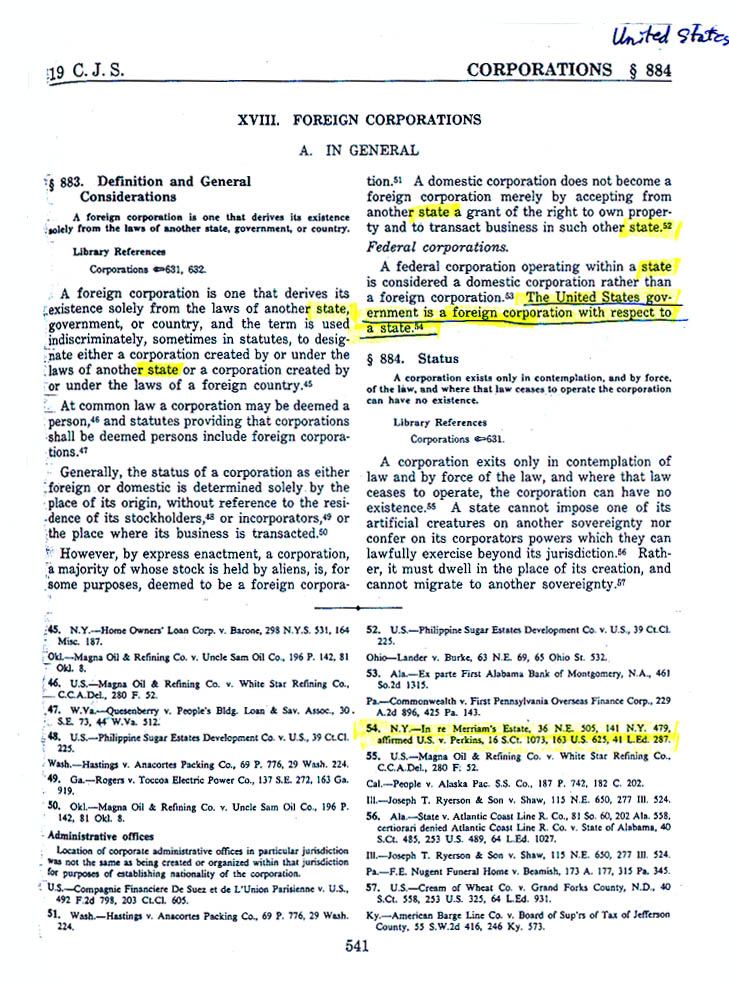
4.2 “foreign countries” or “foreign states” with respect to federal legislative jurisdiction.“The United States Government is a foreign corporation with respect to a state.” [N.Y. v. re Merriam 36 N.E. 505; 141 N.Y. 479; affirmed 16 S.Ct. 1073; 41 L. Ed. 287]
[19 Corpus Juris Secundum (C.J.S.), Corporations, §884]
4.3 Addressed as “states” rather than “States” in federal law because they are foreign.
4.4 The equivalent of independent nations in in respect to federal jurisdiction excepting the subject of foreign affairs.Case Syllabus
"The States between each other are sovereign and independent. They are distinct and separate sovereignties, except so far as they have parted with some of the attributes of sovereignty by the Constitution. They continue to be nations, with all their rights, and under all their national obligations, and with all the rights of nations in every particular; except in the surrender by each to the common purposes and objects of the Union, under the Constitution. The rights of each State, when not so yielded up, remain absolute."
[Bank of Augusta v. Earle, 38 U.S. (13 Pet.) 519; 10 L.Ed. 274 (1839)]
Many Americans naturally cringe at the idea of being called a “foreigner” in their own country. The purpose of this section is to explain why there is nothing wrong with maintaining the status of being “foreign” and why it is the ONLY way to preserve and protect the separation of powers that was put into place by the very wise founding fathers for the explicit purpose of protecting our sacred Constitutional Rights.
The U.S. Supreme Court described how legal entities and persons transition from being FOREIGN to DOMESTIC in relation to a specific court or venue, which is ONLY with their express consent. This process of giving consent is also called a "waiver of sovereign immunity" and it applies equally to governments, states, and the humans occupying them. To wit:
Before we can proceed in this cause we must, therefore, inquire whether we can hear and determine the matters in controversy between the parties, who are two states of this Union, sovereign within their respective boundaries, save that portion of power which they have granted to the federal government, and foreign to each other for all but federal purposes. So they have been considered by this Court, through a long series of years and cases, to the present term; during which, in the case of The Bank of the United States v. Daniels, this Court has declared this to be a fundamental principle of the constitution; and so we shall consider it in deciding on the present motion. 2 Peters, 590, 91.
Those states, in their highest sovereign capacity, in the convention of the people thereof; on whom, by the revolution, the prerogative of the crown, and the transcendant power of parliament devolved, in a plenitude unimpaired by any act, and controllable by no authority, 6 Wheat. 651; 8 Wheat. 584, 88; adopted the constitution, by which they respectively made to the United States a grant of judicial power over controversies between two or more states. By the constitution, it was ordained that this judicial power, in cases where a state was a party, should be exercised by this Court as one of original jurisdiction. The states waived their exemption from judicial power, 6 Wheat. 378, 80, as sovereigns by original and inherent right, by their own grant of its exercise over themselves in such cases, but which they would not grant to any inferior tribunal. By this grant, this Court has acquired jurisdiction over the parties in this cause, by their own consent and delegated authority; as their agent for executing the judicial power of the United States in the cases specified.
The idea of the above cite is that all civil subject matters or powers by any government NOT expressly consented to by the object of those powers are foreign and therefore outside the civil legal jurisdiction of that government. This fact is recognized in the Declaration of Independence, which states that all just powers derive from the CONSENT of those governed. The method of providing that consent , in the case of a human, is to select a civil domicile within a specific government and thereby nominate a protector under the civil statutory laws of the territory protected by that government. This fact is recognized in Federal Rule of Civil Procedure 17(b), which says that the capacity to sue or be sued is determined by the law of the domicile of the party. Civil statutory laws from places or governments OUTSIDE the domicile of the party may therefore NOT be enforced by a court against the party. This subject is covered further in:
Why domicile and becoming a "taxpayer" require your consent
http://famguardian.org/Subjects/Taxes/Remedies/DomicileBasisForTaxation.htm
A very important aspect of domicile is that whether one is domestic and a citizen or foreign under the civil statutory laws is determined SOLELY by one's domicile, and NOT their nationality. You can be born anywhere in America and yet still be a non-resident non-person in relation to any and every state or government within America simply by not choosing or having a domicile within any municipal government in the country. You can also be a statutory "non-resident non-person" in relation to the national government and yet still have a civil domicile within a specific state of the Union, because your DOMICILE is foreign, not your nationality.
Consistent with the above analysis of how one transitions from FOREIGN to DOMESTIC through CONSENT are the following corroborating authorities.
- The Declaration of Independence, which says that all JUST powers derive ONLY from the “consent of the governed”. Anything not consensual is therefore unjust and does not therefore have the “force of law” or any civil jurisdiction whatsoever against those not consenting.
DECLARATION OF INDEPENDENCE, 1776
"We hold these truths to be self-evident, that all men are created equal, that they are endowed by their Creator with certain unalienable Rights, that among these are Life, Liberty and the pursuit of Happiness.--That to secure these rights, Governments are instituted among Men, deriving their just powers from the consent of the governed,"
[Declaration of Independence, 1776] - The concept of “comity” in legal field:
comity. Courtesy; complaisance; respect; a willingness to grant a privilege, not as a matter of right, but out of deference and good will. Recognition that one sovereignty allows within its territory to the legislative, executive, or judicial act of another sovereignty, having due regard to rights of its own citizens. Nowell v. Nowell, Tex.Civ.App., 408 S.W.2d. 550, 553. In general, principle of "comity" is that courts of one state or jurisdiction will give effect to laws and judicial decisions of another state or jurisdiction, not as a matter of obligation, but out of deference and mutual respect. Brown v. Babbitt Ford, Inc., 117 Ariz. 192, 571 P.2d. 689, 695. See also Full faith and credit clause.
[Black's Law Dictionary, Sixth Edition, p. 267] - The Foreign Sovereign Immunities Act (F.S.I.A.), 28 U.S.C. Chapter 97.
- The Minimum Contacts Doctrine of the U.S. Supreme Court. See International Shoe Co. v. Washington, 326 U.S. 310 (1945).
- The Longarm Statutes within your state. Each state has statutes authorizing nonresidents and therefore foreign sovereigns to waive their sovereign immunity in civil court.
Going along with the notion of the Separation Of Powers doctrine in the previous section is the concept of “sovereignty”. Sovereignty is the foundation of all government in America and fundamental to understanding our American system of government. Below is how President Theodore Roosevelt, one of our most beloved Presidents, describes “sovereignty”:
“We of this mighty western Republic have to grapple with the dangers that spring from popular self-government tried on a scale incomparably vaster than ever before in the history of mankind, and from an abounding material prosperity greater also than anything which the world has hitherto seen.
As regards the first set of dangers, it behooves us to remember that men can never escape being governed. Either they must govern themselves or they must submit to being governed by others. If from lawlessness or fickleness, from folly or self-indulgence, they refuse to govern themselves then most assuredly in the end they will have to be governed from the outside. They can prevent the need of government from without only by showing they possess the power of government from within. A sovereign cannot make excuses for his failures; a sovereign must accept the responsibility for the exercise of power that inheres in him; and where, as is true in our Republic, the people are sovereign, then the people must show a sober understanding and a sane and steadfast purpose if they are to preserve that orderly liberty upon which as a foundation every republic must rest.”
[President Theodore Roosevelt; Opening of the Jamestown Exposition; Norfolk, VA, April 26, 1907]
In this section, we will cover some very important implications of sovereignty within the context of government authority and jurisdiction generally. We will analyze these implications both from the standpoint of relations WITHIN a government and the relationship that government has with its citizens and subjects. We will expand upon the subject of sovereignty in the context of taxes later in sections 5.2.2 and 5.2.3.
Sovereignty can exist within individuals, families, churches, cities, counties, states, nations, and even international bodies. This is depicted in the “onion diagram” below, which shows the organization of civil government graphically. The boundaries between each level of government are defined by God Himself, who is the Creator of all things and the Author of the user manual for it all, His Holy Book. Each level of the “onion” below is considered sovereign, independent, and “foreign” with respect to all the levels external to it. Each level of the diagram represents an additional layer of protection for those levels within it, keeping in mind that the purpose of government at every level is “protection” of the sovereigns which it was created to serve and which are within it in the diagram below:
Figure 4‑3: Hierarchy of sovereignty
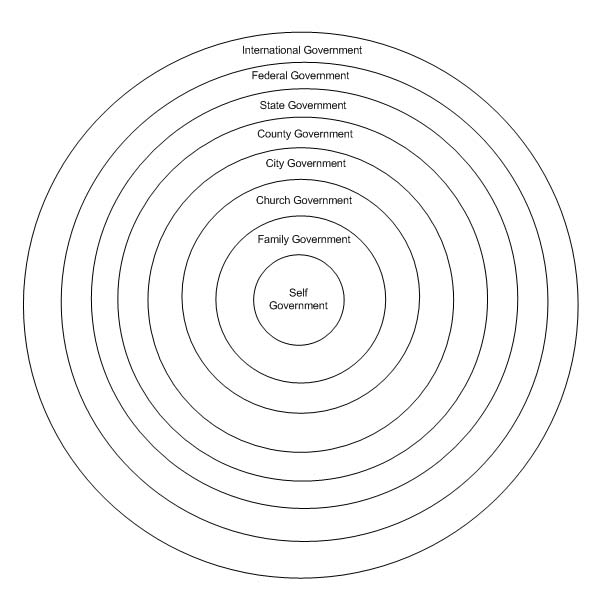
The interior levels of the above onion govern and direct the external levels of the onion. For instance, citizens govern and direct their city, county, state, and federal governments by exercising their political right to vote and serve on jury duty. Here is how the Supreme Court describes it:
“The words 'people of the United States' and 'citizens,' are synonymous terms, and mean the same thing. They both describe the political body who, according to our republican institutions, form the sovereignty, and who hold the power and conduct the government through their representatives. They are what we familiarly call the 'sovereign people,' and every citizen is one of this people, and a constituent member of this sovereignty. ..."
[Boyd v. State of Nebraska, 143 U.S. 135 (1892)]
"...at the Revolution, the sovereignty devolved on the people; and they are truly the sovereigns of the country, but they are sovereigns without subjects...with none to govern but themselves; the citizens of America are equal as fellow citizens, and as joint tenants in the sovereignty."
[Chisholm v. Georgia, 2 Dall (U.S.) 419, 454, 1 L.Ed. 440, 455 @DALL 1793, pp. 471-472]
City governments control their state governments by directing elections, controlling what appears on the ballot, and controlling how much of the property and sales tax revenues are given to the states. State government exercise their authority over the federal government by sending elected representatives to run the Senate and by controlling the “purse” of the federal government when direct taxes are apportioned to states.
Sovereignty also exists within a single governmental unit. For instance, in the previous section, we described the Separation of Powers Doctrine by showing how a “republican form of government” divides the federal government into three distinct, autonomous, and completely independent branches that are free from the control of the other branches. Therefore, the Executive, Legislative, and Judicial departments of both state and federal governments are “foreign” and “alien” with respect to the other branches.
Sovereignty is defined in man’s law as follows, in Black’s Law Dictionary:
“Sovereignty. The supreme, absolute, and uncontrollable power by which any independent state is governed; supreme political authority; paramount control of the constitution and frame of government and its administration; self sufficient source of political power, from which all specific political powers are derived; the international independence of a state, combined with the right and power of regulating its internal affairs without foreign dictation; also a political society, or state, which is sovereign and independent. Chisholm v. Georgia, 2 Dall. 455, 1 L.Ed. 440; Union Bank v. Hill, 3 Cold., Tenn 325; Moore v. Shaw, 17 Cal. 218, 79 Am.Dec. 123; State v. Dixon, 66 Mont. 76, 213 P. 227.”
[Black’s Law Dictionary 4th Edition (1951), page 1568]
“Sovereignty” consists of the combination of legal authority and responsibility that a government or individual has within our American system of jurisprudence. The key words in the above definition of sovereignty are: “foreign”, “uncontrollable”, and “independence”. A “sovereign” is:
- A servant and fiduciary of all sovereigns internal to it.
- Not subject to the legislative or territorial jurisdiction of any external sovereign. This is because he is the “author” of the law that governs the external sovereign and therefore not subject to it.
“Sovereignty itself is, of course, not subject to law, for it is the author and source of law…While sovereign powers are delegated to…the government, sovereignty itself remains with the people.”
[Yick Wo v. Hopkins, 118 U.S. 356 (1886)] - “Foreign” but not a privileged "alien" with respect to other external sovereigns, from a legal perspective. This means that:
3.1. The purpose of the laws of the sovereign at any level is to establish a fiduciary duty to protect the rights and sovereignty of all those entities which are internal to a sovereignty.
3.2. The existence of a sovereign may be acknowledged and defined, but not limited by the laws of an external sovereign.
3.3. The rights and duties of a sovereign are not prescribed in any law of an external sovereign.
-
“Independent” of other sovereigns. This means that:
4.1. The sovereign has a duty to support and govern itself completely and to not place any demands for help upon an external sovereign.
4.2. The moment a sovereign asks for “benefits” or help, it ceases to be sovereign and independent and must surrender its rights and sovereignty to an external sovereign using his power to contract in order to procure needed help.
The purpose of the Constitution is to preserve “self-government” and independence at every level of sovereignty in the above onion diagram:
“The determination of the Framers Convention and the ratifying conventions to preserve complete and unimpaired state [and personal] self-government in all matters not committed to the general government is one of the plainest facts which emerges from the history of their deliberations. And adherence to that determination is incumbent equally upon the federal government and the states. State powers can neither be appropriated on the one hand nor abdicated on the other. As this court said in Texas v. White, 7 Wall. 700, 725, 'The preservation of the States, and the maintenance of their governments, are as much within the design and care of the Constitution as the preservation of the Union and the maintenance of the National government. The Constitution, in all its provisions, looks to an indestructible Union, composed of indestructible States.' Every journey to a forbidden end begins with the first step; and the danger of such a step by the federal government in the direction of taking over the powers of the states is that the end of the journey may find the states so despoiled of their powers, or-what may amount to the same thing-so [298 U.S. 238, 296] relieved of the responsibilities which possession of the powers necessarily enjoins, as to reduce them to little more than geographical subdivisions of the national domain. It is safe to say that if, when the Constitution was under consideration, it had been thought that any such danger lurked behind its plain words, it would never have been ratified. “
[Carter v. Carter Coal Co., 298 U.S. 238 (1936)]
Below are some examples of the operation of the above rules for sovereignty within the American system of government:
- No federal law prescribes a duty upon a person who is a “national” but not a “citizen” under federal law, as defined in 8 U.S.C. §1101(a)(21), 8 U.S.C. §1101(a)(22)(B), or 8 U.S.C. §1452. References to “nationals” within federal law are rare and every instance where it is mentioned is in the context of duties and obligations of public servants, rather than the “national himself” or herself. We will expand further upon this subject later in section 4.11.1 and following.
- Natural persons who have not expressly and in writing contracted away their rights are “sovereign”. Here is how the U.S. Supreme Court describes it:
"There is a clear distinction in this particular case between an individual and a corporation, and that the latter has no right to refuse to submit its books and papers for an examination at the suit of the State. The individual may stand upon his constitutional rights as a citizen. He is entitled to carry on his private business in his own way. His power to contract is unlimited. He owes no such duty to the State, since he receives nothing therefrom, beyond the protection of his life and property. His rights are such as existed by the law of the land long antecedent to the organization of the State, and can only be taken from him by due process of law, and in accordance with the constitution. Among his rights are a refusal to incriminate himself, and the immunity of himself and his property from arrest or seizure except under a warrant of the law. He owes nothing to the public so long as he does not trespass upon their rights."
[Hale v. Henkel, 201 U.S. 43 at 47 (1905)] - States of the Union and the Federal government are both immune from lawsuits against them by “nationals”, except in cases where they voluntarily consent by law. This is called “sovereign immunity”. Read the Supreme Court case of Alden v. Maine, 527 U.S. 706 (1999) for exhaustive details on the constitutional basis for this immunity.
- States of the Union are “foreign” with respect to the federal government for the purposes of legislative jurisdiction. In federal law, they are called “foreign states” and they are described with the lower case word “states” within the U.S. Code and in upper case “States” in the Constitution. Federal “States”, which are are actually territories of the United States (see 4 U.S.C. §110(d)) are spelled in upper case in most federal statutes and codes. States of the Union are immune from the jurisdiction of federal courts, except in cases where they voluntarily consent to be subject to the jurisdiction. The federal government is immune from the jurisdiction of state courts and international bodies, except where it consents to be sued as a matter of law. This is called “sovereign immunity”.
Foreign States: “Nations outside of the United States…Term may also refer to another state; i.e. a sister state. The term ‘foreign nations’, …should be construed to mean all nations and states other than that in which the action is brought; and hence, one state of the Union is foreign to another, in that sense.”
[Black’s Law Dictionary, 6th Edition, p. 648]Foreign Laws: “The laws of a foreign country or sister state. In conflicts of law, the legal principles of jurisprudence which are part of the law of a sister state or nation. Foreign laws are additions to our own laws, and in that respect are called 'jus receptum'."
[Black’s Law Dictionary, 6th Edition, p. 647] - The rules for surrendering sovereignty are described in the “Foreign Sovereign Immunities Act”, which is codified in 28 U.S.C. §§1602-1611. A list of exceptions to the act in 28 U.S.C. §1605 define precisely what behaviors cause a sovereign to surrender their sovereignty to a fellow or sovereign.
The key point we wish to emphasize throughout this section is that a sovereign is “foreign” with respect to all other external (outside them within the onion diagram) sovereigns. In that respect, a sovereign is considered a “foreigner” of one kind or another in the laws of every sovereign external to it. For instance, a human being who is a “national” but not a subject STATUTORY “citizen” under federal law, as defined in 8 U.S.C. §1101(a)(21) or 8 U.S.C. §1452, is classified as a “nonresident alien” within the Internal Revenue Code if he is engaged in a public office and a "non-resident non-person" if he is not. He is “alien” to the code because he is not subject to it and he is a “nonresident” because he does not maintain a domicile in the federal zone. This is no accident, but simply proof in the law itself that such a person is in deed and in fact a “sovereign” with respect to the government entity that serves him. Understanding this key point is the foundation for understanding the next chapter, where we will prove to you with the government’s own laws that most Americans born in and living within states of the Union, which are “foreign states” with respect to federal jurisdiction, are:
- Statutory “non-resident non-persons” if they are not engaged in a public office.
- “nonresident aliens” as defined under 26 U.S.C. §7701(b)(1)(B) if they are engaged in a public office in the national government
- Not“persons” or “individuals” within federal civil law, including the Internal Revenue Code. You can’t be a “person” or an “individual” within federal law unless you either have a domicile within federal jurisdiction or contract with the federal government to procure an identity or “res” within their jurisdiction and thereby become a “res-ident”. The U.S. Supreme Court has held that the rights of human beings are unalienable, which means they can’t be bargained or contracted away through any commercial process. Therefore, domicile is the only lawful source of jurisdiction over human beings.
“Men are endowed by their Creator with certain unalienable rights,-'life, liberty, and the pursuit of happiness;' and to 'secure,' not grant or create, these rights, governments are instituted. That property [or income] which a man has honestly acquired he retains full control of. . .”
[Budd v. People of State of New York, 143 U.S. 517 (1892)]Furthermore, the Bible says we can’t contract with “the Beast”, meaning the government and therefore, we have no delegated authority to give away our rights to the government:
“You shall make no covenant [contract or franchise] with them [foreigners, pagans], nor with their [pagan government] gods [laws or judges]. They shall not dwell in your land [and you shall not dwell in theirs by becoming a “resident” in the process of contracting with them], lest they make you sin against Me [God]. For if you serve their gods [under contract or agreement or franchise], it will surely be a snare to you.”
[Exodus 23:32-33, Bible, NKJV] - Not “nonresident alien individuals”. You can’t be a “nonresident alien individual” without first being an “individual” and therefore a “person”. 26 U.S.C. §7701(a)(1) defines the term “person” to include “individuals”. Instead, they are “non-resident NON-persons”.
- “foreign” or “foreigners” with respect to federal jurisdiction. All of their property is classified as a “foreign estate” under 26 U.S.C. §7701(a)(31). In the Bible, this status is called a “stranger”:
“You shall neither mistreat a stranger nor oppress him, for you were strangers in the land of Egypt.”
[Exodus 22:21, Bible, NKJV]“And if a stranger dwells with you in your land, you shall not mistreat him.”
[Leviticus 19:33, Bible, NKJV] -
Not “foreign persons”. You can’t be a “foreign person” without first being a “person”.
- “nontaxpayers” if they do not earn any income from within the “federal zone” or that is connected with an excise taxable activity called a “trade or business”, which is defined in 26 U.S.C. §7701(a)(26) as a public office in the United States government.
- Not qualified to sit on a jury in a federal district court, because they are not statutory “citizens” under federal law.
Now do you understand why the Internal Revenue Code defines the term “foreign” as follows? They don’t want to spill the beans and inform you that you are sovereign and not subject to their jurisdiction! The definition of "foreign" in the Internal Revenue Code defines the term ONLY in the context of corporations, because the government only has civil statutory jurisdiction over PUBLIC statutory "persons" that they created and who are therefore engaged in a public office, of which federal corporations are a part:
The reason they defined "foreign" as they did above is that:26 U.S. Code § 7701 - Definitions
(a) When used in this title, where not otherwise distinctly expressed or manifestly incompatible with the intent thereof—
(3) Corporation
The term “corporation” includes associations, joint-stock companies, and insurance companies.
(4) Domestic
The term “domestic” when applied to a corporation or partnership means created or organized in the United States or under the law of the United States or of any State unless, in the case of a partnership, the Secretary provides otherwise by regulations.
(5) Foreign
The term “foreign” when applied to a corporation or partnership means a corporation or partnership which is not domestic.
- The “United States” government is a “foreign corporation” in respect to a state. Everything OUTSIDE that corporation is “foreign”.
"The United States government is a foreign corporation with respect to a state."
[19 Corpus Juris Secundum (C.J.S.), Corporations, §883 (2003)]"Corporations are also of all grades, and made for varied objects; all governments are corporations, created by usage and common consent, or grants and charters which create a body politic for prescribed purposes; but whether they are private, local or general, in their objects, for the enjoyment of property, or the exercise of power, they are all governed by the same rules of law, as to the construction and the obligation of the instrument by which the incorporation is made. One universal rule of law protects persons and property. It is a fundamental principle of the common law of England, that the term freemen of the kingdom, includes 'all persons,' ecclesiastical and temporal, incorporate, politique or natural; it is a part of their magna charta (2 Inst. 4), and is incorporated into our institutions. The persons of the members of corporations are on the same footing of protection as other persons, and their corporate property secured by the same laws which protect that of individuals. 2 Inst. 46-7. 'No man shall be taken,' 'no man shall be disseised,' without due process of law, is a principle taken from magna charta, infused into all our state constitutions, and is made inviolable by the federal government, by the amendments to the constitution."
[Proprietors of Charles River Bridge v. Proprietors of Warren Bridge, 36 U.S. 420 (1837)]TITLE 28 - JUDICIARY AND JUDICIAL PROCEDURE
PART VI - PARTICULAR PROCEEDINGS
CHAPTER 176 - FEDERAL DEBT COLLECTION PROCEDURE
SUBCHAPTER A - DEFINITIONS AND GENERAL PROVISIONS
Sec. 3002. Definitions
(15) ''United States'' means -
(A) a Federal corporation;
(B) an agency, department, commission, board, or other entity of the United States; or
(C) an instrumentality of the United States. - The only thing legally INSIDE the “United States” corporation as a legal person are public officers and federal instrumentalities such as OTHER federal corporations.
- The government can only regulate or control that which it creates, and it didn’t create state corporations. Legislatively foreign states did that. State corporations are therefore OUTSIDE the “United States” corporation and foreign to it because not created by the United States government.
- The power to tax is the power to create. They can't tax what they didn't create, meaning they can't tax PRIVATE human beings. PRIVATE human beings are not statutory "persons" or "taxpayers" within the Internal Revenue Code UNLESS they are serving in public offices within the national and not state government.
- They know they only have jurisdiction over PUBLIC entities lawfully engaged in public offices WITHIN the government, all of which they CREATED by statute.
- The term "United States" in statutes has TWO possible meanings in statutes such as the I.R.C.:
6.1. The GEOGRAPHICAL "United States" consisting of Federal territory,
6.2. The "United States" federal corporation 28 U.S.C. §3002(15)(A). - Most uses of "United States" within the I.R.C. rely on the SECOND definition, including the term "sources within the United States" found in 26 U.S.C. §864(c)(3). That means a “source in the United States” really means an OFFICE or INSTRUMENTALITY within the United States federal corporation.
- They want to promote false presumption about federal jurisdiction by making everyone falsely believe that they are a statutory "person" or "taxpayer" and therefore a public office in the national government. Acting as a "public officer" makes an otherwise private human being INTO a public office and therefore LEGALLY but not GEOGRAPHICALLY "within" the "United States" federal corporation.
- They want to create and exploit “cognitive dissonance” by appealing to the aversion of the average American to being called a “foreigner” or “non-resident non-person” with respect to his own federal government.
- They want to mislead and deceiving Americans into believing and declaring on government forms that they are statutory rather than constitutional “U.S. citizens” pursuant to 8 U.S.C. §1401 who are subject to their corrupt laws instead of “nationals” but not a “citizens” pursuant to 8 U.S.C. §1101(a)(21). The purpose is to compel you through constructive fraud to associate with and conduct “commerce” (intercourse/fornication) with “the Beast” as a statutory “U.S. citizen”, who is a government whore. They do this by the following means:
10.1. Using “words of art” to encourage false presumption.
10.2. Using vague or ambiguous language that is not defined and using political propaganda instead of law to define the language.
Keep in mind the following with respect to “foreigners” and the status of being an “non-resident non-person” as a sovereign:
- What makes you legislatively “foreign” in respect to a specific jurisdiction or venue is a foreign DOMICILE, not a foreign NATIONALITY.
- Federal Rule of Civil Procedure 17(b) is the method of enforcing your foreign status, because it recognizes that those who are not domiciled on federal territory are beyond the civil statutory jurisdiction of the court. This does NOT mean that you are beyond the jurisdiction of the COMMON law within that jurisdiction, but simply not beyond the STATUTORY control of that jurisdicton.
- The only way an otherwise PRIVATE human being not domiciled on federal territory can be treated AS IF they are is if they are lawfully engaged in a public office within the national and not state government.
- There is nothing wrong with being an “alien” in the tax code, as long as we aren’t an alien with a “domicile” in the District of Columbia, which makes us into a “resident”. The taxes described under Subtitle A of the Internal Revenue Code are not upon “aliens”, but instead mainly upon “residents”, who are “aliens” with a legal domicile within federal exclusive jurisdiction. We cover this in section 5.4.19 of the Great IRS Hoax.
- A “non-resident non-person” is not an “alien” and therefore not a “taxpayer” in most cases. 8 U.S.C. §1101(a)(3) and 26 C.F.R. §1.1441-1(c)(3)(i) both define an “alien” as “any person who is neither a citizen nor national of the United States”. 26 U.S.C. §7701(b)(1)(B) defines a “nonresident alien” as “neither a citizen of the United States nor a resident of the United States (within the meaning of subparagraph (A))”. Note that one can be a “national” or a “state national” and STILL satisfy the requirement in 26 U.S.C. §7701(b)(1)(B) to be NEITHER a “citizen” nor a “resident”. We clarify this concept further in section 10.2.
- A “nonresident alien” who is also an “alien” may elect under 26 U.S.C. §6013(g) or 26 U.S.C. §7701(b)(4) to be treated as a “resident” by filing the wrong tax form, the 1040, instead of the more proper 1040NR form. Since that election is a voluntary act, then income taxes are voluntary for nonresident aliens.
- A “nonresident alien” who is a non-citizen national may not lawfully elect to become a “resident alien” or a “resident” pursuant to 26 U.S.C. §6013(g) or 26 U.S.C. §7701(b)(4).
- The only way that a “nonresident alien” who is also a “non-citizen national” can lawfully become domiciled in a place is if he or she or it physically moves to that place and then declares an intention to remain permanently and indefinitely. When the nonresident alien does this, it becomes a statutory citizen of that place, not a “resident alien”.
- Only “aliens” can have a “residence” within the Internal Revenue Code pursuant to 26 C.F.R. §1.871-2. Non-citizen nationals cannot lawfully be described as having a “residence” because that word is nowhere defined to include “non-citizen nationals” with a domicile or abode on federal territory.
If you would like to learn more about the rules that govern sovereign relations at every level, please refer to the table below:
Table 6: Rules for Sovereign Relations/Government
| # | Sovereignty | Governance and Relations with other Sovereigns Prescribed By |
|
| God’s law | Man’s law | ||
| 1 | Self government | Bible Family Constitution |
Criminal code. All other “codes” are voluntary and consensual. |
| 2 | Family government | Bible Family Constitution Sovereign Christian Marriage |
Family Code in most states, but only for those who get a state marriage license. |
| 3 | Church government | Bible Family Constitution |
Not subject to government jurisdiction under the Separation of Powers Doctrine |
| 4 | City government | Bible | Municipal code |
| 5 | County government | Bible | County code |
| 6 | State government | Bible | United State Constitution State Constitution State Code |
| 7 | Federal government | Bible | United State Constitution Statutes at Large United States Code Code of Federal Regulations |
| 8 | International government | Bible | Law of Nations, Vattel |
NOTES:
1. The Sovereign Christian Marriage, Form #06.009 book above may be downloaded from the Family Guardian website at:
http://sedm.org/ItemInfo/Ebooks/SovChristianMarriage/SovChristianMarriage.htm
2. The Family Constitution above may be downloaded for free from the Family Guardian website at:
http://famguardian.org/Publications/FamilyConst/FamilyConst.htm
3. Man’s laws may be referenced on the Family Guardian website at:
http://famguardian.org/TaxFreedom/LegalRef/LegalResrchSrc.htm
4. God’s laws are summarized on the Family Guardian Website below:
http://famguardian.org/Subjects/LawAndGovt/ChurchVState/BibleLawIndex/bl_index.htm
5. You can read The Law of Nations book mentioned above on the Family Guardian website at:
http://famguardian.org/Publications/LawOfNations/vattel.htm
This concept of being a “foreigner” or statutory “non-resident non-person” as a sovereign is also found in the Bible as well. Remember what Jesus said about being free?:
"Ye shall know the Truth and the Truth shall make you free."
[John 8:32, Bible, NKJV]
We would also add to the above that the Truth shall also make you a “non-resident non-person” under the civil statutory “codes”/franchises of your own country! Below are a few examples why:
"Adulterers and adulteresses! Do you now know that friendship [and "citizenship"] with the world [or the governments of the world] is enmity with God? Whoever therefore wants to be a friend ["citizen" or "taxpayer" or "resident" or "inhabitant"] of the world makes himself an enemy of God."
[James 4:4, Bible, NKJV]"For our citizenship is in heaven [and not earth], from which we also eagerly wait for the Savior, the Lord Jesus Christ"
[Philippians 3:20, Bible, NKJV]"I am a stranger in the earth; Do not hide Your commandments [laws] from me."
[Psalm 119:19, Bible, NKJV]“I have become a stranger to my brothers, and an alien to my mother's children; because zeal for Your [God's] house has eaten me up, and the reproaches of those who reproach You have fallen on me.”
[Psalm 69:8-9, Bible, NKJV]
It is one of the greatest ironies of law and government that the only way you can be free and sovereign is to be an “foreigner” or what the Bible calls a “stranger” of one kind or another within the law, and to understand the law well enough to be able to describe exactly what kind of “foreigner” you are and why, so that the government must respect your sovereignty and thereby leave you and your property alone.
"The makers of our Constitution undertook to secure conditions favorable to the pursuit of happiness. They recognized the significance of man's spiritual nature, of his feelings and of his intellect. They knew that only a part of the pain, pleasure and satisfactions of life are to be found in material things. They sought to protect Americans in their beliefs, their thoughts, their emotions and their sensations. They conferred, as against the Government, the right to be let alone - the most comprehensive of rights and the right most valued by civilized men."
[Olmstead v. United States, 277 U.S. 438, 478 (1928) (Brandeis, J., dissenting); see also Washington v. Harper, 494 U.S. 210 (1990)]
The very object of "justice" itself is to ensure that people are "left alone". The purpose of courts is to enforce the requirement to leave our fellow man alone and to only do to him/her what he/she expressly consents to and requests to be done:
PAULSEN, ETHICS (Thilly's translation), chap. 9.
“Justice, as a moral habit, is that tendency of the will and mode of conduct which refrains from disturbing the lives and interests of others, and, as far as possible, hinders such interference on the part of others. This virtue springs from the individual's respect for his fellows as ends in themselves and as his co equals. The different spheres of interests may be roughly classified as follows: body and life; the family, or the extended individual life; property, or the totality of the instruments of action; honor, or the ideal existence; and finally freedom, or the possibility of fashioning one's life as an end in itself. The law defends these different spheres, thus giving rise to a corresponding number of spheres of rights, each being protected by a prohibition. . . . To violate the rights, to interfere with the interests of others, is injustice. All injustice is ultimately directed against the life of the neighbor; it is an open avowal that the latter is not an end in itself, having the same value as the individual's own life. The general formula of the duty of justice may therefore be stated as follows: Do no wrong yourself, and permit no wrong to be done, so far as lies in your power; or, expressed positively: Respect and protect the right.”
[Readings on the History and System of the Common Law, Second Edition, 1925, Roscoe Pound, p. 2]
A person who is “sovereign” must be left alone as a matter of law. There are several examples of this important principle of sovereignty in operation in the Bible as well. For example:
Then Haman said to King Ahasuerus, “There is a certain people scattered and dispersed among the people in all the provinces of your kingdom; their laws are different from all other people’s, and they do not keep the king’s laws [are FOREIGN with respect to them and therefore sovereign]. Therefore it is not fitting for the king to let them remain. If it pleases the king, let a decree be written that they be destroyed, and I will pay ten thousand talents of silver into the hands of those who do the work, to bring it into the king’s treasuries.”
[Esther 3:8-9, Bible, NKJV]
In the Bible, when the Jews were being embarrassed and enslaved by surrounding heathen populations, they responded in the Book of Nehemiah by building a wall around their city and being self-contained and self-governing to the exclusion of the “aliens” and “foreigners” around them, who were not believers. This is their way of not only restoring self-government, but of also restoring God as their King and Sovereign, within what actually amounted to a “theocracy”:
"The survivors [Christians] who are left from the captivity in the province are there in great distress and reproach. The wall [of separation between "church", which was the Jews, and "state", which was the heathens around them] of Jerusalem is also broken down, and its gates are burned with fire."
[Neh. 1:3, Bible, NKJV]
Then I said to them, "You see the distress that we are in, how Jerusalem lies waste, and its gates are burned with fire. Come and let us build the wall of [of separation in] Jerusalem that we may no longer be a reproach." And I told them of the hand of my God which had been good upon me, and also of the king's words that he had spoken to me. So they said, "Let us rise up and build." Then they set their hands to this good work.
But when Sanballat the Horonite, Tobiah the Ammonite official, and Geshem the Arab heard of it, they laughed at us and despised us, and said, "What is this thing that you are doing? Will you rebel against the king?"
So I answered them, and said to them, "The God of heaven Himself will prosper us; therefore we His servants will arise and build [the wall of separation between church and state]..."
[Neh. 3:17-18, Bible, NKJV]
The “wall” of separation between “church”, which was the Jews, and “state”, which was the surrounding unbelievers and governments, they were talking about above was not only a physical wall, but also a legal one as well! The Jews wanted to be “separate”, and therefore “sovereign” over themselves, their families, and their government and not be subject to the surrounding heathens and nonbelievers around them. They selected Heaven as their "domicile" and God's laws as the basis for their self-government, which was a theocracy, and therefore became "strangers" on the earth who were hated by their neighbors. The Lord, in wanting us to be sanctified and “separate” as His “bride”, is really insisting that we also be a “foreigner” or “stranger” with respect to our unbelieving neighbors and the people within the heathen state that has territorial jurisdiction where we physically live:
"Come out from among them [the unbelievers and government idolaters]
And be separate [“sovereign” and “foreign”], says the Lord.
Do not touch what is unclean [corrupted],
And I will receive you.
I will be a Father to you,
And you shall be my sons and daughters,
Says the Lord Almighty."
[2 Corinthians 6:17-18, Bible, NKJV]
When we follow the above admonition of our Lord to become “sanctified” and therefore “separate”, then we will inevitably be persecuted, just as Jesus warned, when He said:
“If the world hates you, you know that it hated Me before it hated you. If you were of the world, the world would love its own. Yet because you are not of the world, but I chose you out of the world, therefore the world hates you. Remember the word that I said to you, ‘A servant is not greater than his master.’ If they persecuted Me, they will also persecute you. If they kept My word, they will keep yours also. But all these things they will do to you for My name’s sake, because they do not know Him who sent Me. If I had not come and spoken to them, they would have no sin, but now they have no excuse for their sin. He who hates me hated My father also. If I had not done among them the works which no one else did, they would have no sin; but now they have seen and also hated both Me and My Father. But this happened that the word might be fulfilled which is written in their law, ‘They hated Me without a cause.’”
[John 15:18-25, Bible, NKJV]
The persecution will come precisely and mainly because we are sovereign and therefore refuse to be governed by any authority except God and His sovereign Law. Now do you understand why Christians, more than perhaps any other faith, have been persecuted and tortured by governments throughout history? The main reason for their relentless persecution is that they are a threat to government power because they demand autonomy and self-government and do not yield their sovereignty to any hostile (“foreign”) power or law other than God and His Holy law. This is the reason, for instance, why the Roman Emperor Nero burned Christians and their houses when he set fire to Rome and why he made them part of the barbaric gladiator spectacle: He positively hated anyone whose personal sovereignty would make his authority and power basically irrelevant and moot and subservient to a sovereign God. He didn’t like being answerable to anyone, and especially not to an omnipotent and omnipresent God. He viewed God as a competitor for the affections and the worship of the people. This is the very reason why we have "separation of church and state" today as part of our legal system: to prevent this kind of tyranny from repeating itself. This same gladiator spectacle is also with us today. It's called an "income tax trial" in the federal church called "district court". Below are just a few examples of the persecution suffered by Jews and Christians throughout history, drawn from the Bible and other sources, mainly because they attempted to fulfill God’s holy calling to be sanctified, separate, sovereign, a “foreigner”, and a "stranger” with respect to the laws, taxes, and citizenship of surrounding heathen people and governments:
- The last several years of the Apostle John’s life were spent in exile on the Greek island of Patmos, where he was sent by the Roman government because he was a threat to the power and influence of Roman civil authorities. During his stay there, he wrote the book of Revelation, which was a cryptic, but direct assault upon government authority.
- Every time Israel was judged in the Book of Judges, they came under “tribute” (taxation and therefore slavery) to a tyrannical king.
- Abraham's great struggles for liberty were against overreaching governments, Genesis 14, 20.
- Isaac struggled against overreaching governments Gen 26.
- Egyptian Pharaohs enslaved God's people, Ex. 1.
- Joshua's battle was against 31 kings in Canaan.
- Israel struggled against the occupation of foreign governments in the Book of Judges
- David struggled against foreign occupation, 2 Samuel 8, 10
- Zechariah lost his life in 2 Chronicles for speaking against a king.
- Isaiah was executed by Manasseh.
- Daniel was oppressed by Officials who accused him of breaking a Persian statutory law.
- Jesus was executed by a foreign power Jn. 18ff.
- Jesus was a victim of Israel's kangaroo court, the Sanhedrin.
- The last 1/4 of the Book of Acts is about Paul's defense against fraudulent accusations.
- The last 6 years of Paul's life was spent in and out prison defending himself against false accusations.
Taxation is the primary means of destroying the sovereignty of a person, family, church, city, state, or nation. Below is the reason why, from a popular bible dictionary:
“TRIBUTE. Tribute in the sense of an impost paid by one state to another, as a mark of subjugation, is a common feature of international relationships in the biblical world. The tributary could be either a hostile state or an ally. Like deportation, its purpose was to weaken a hostile state. Deportation aimed at depleting the man-power. The aim of tribute was probably twofold: to impoverish the subjugated state and at the same time to increase the conqueror’s own revenues and to acquire commodities in short supply in his own country. As an instrument of administration it was one of the simplest ever devised: the subjugated country could be made responsible for the payment of a yearly tribute. Its non-arrival would be taken as a sign of rebellion, and an expedition would then be sent to deal with the recalcitrant. This was probably the reason for the attack recorded in Gn. 14.
[New Bible Dictionary. Third Edition. Wood, D. R. W., Wood, D. R. W., & Marshall, I. H. 1996, c1982, c1962. InterVarsity Press: Downers Grove]
If you want to be “sovereign”, then you had better get used to the following:
- Supporting yourself and governing your own families and churches, to the exclusion of any external sovereignty. This will ensure that you never have to surrender any aspect of your sovereignty to procure needed help.
- Learning and obeying God’s laws.
- Being a “foreigner”, “stranger”, or civil statutory “non-resident non-person” in your own land.
- Being persecuted by the people and governments around you because you insist on being “foreign” and “different” from the rest of the “sheep” around you.
If you aren’t prepared to do the above and thereby literally “earn” the right to be free and “sovereign”, just as our founding fathers did, then you are literally wasting your time to read further in this book. Doing so will make you into nothing more than an informed coward. Earning liberty and sovereignty in this way is the essence of why America is called:
“The land of the free and the home of the brave.”
It takes courage to be brave enough to be different from all of your neighbors and all the other countries in the world, and to take complete and exclusive responsibility for yourself and your loved ones. Below is what happened to the founding fathers because they took this brave path in the founding of this country. Most did so based on the Christian principles mentioned above. At the point when they committed to the cause, they renounced their British citizenship and because “aliens” with respect to the British Government, just like you will have to do by becoming a “national” but not a “citizen” under federal law:
And, for the support of this Declaration, with a firm reliance on the protection of Divine Providence, we mutually pledge to each other our lives, our fortunes, and our Sacred honor
Have you ever wondered what happened to the fifty-six men who signed the Declaration of Independence? This is the price they paid:
Five signers were captured by the British as traitors, and tortured before they died. Twelve had their homes ransacked and burned. Two lost their sons in the revolutionary army, another had two sons captured. Nine of the fifty-six fought and died from wounds or hardships resulting from the Revolutionary War.
These men signed, and they pledged their lives, their fortunes, and their sacred honor!
What kind of men were they? Twenty five were lawyers or jurists. Eleven were merchants. Nine were farmers or large plantation owners. One was a teacher, one a musician, one a printer. Two were manufacturers, one was a minister. These were men of means and education, yet they signed the Declaration of Independence, knowing full well that the penalty could be death if they were captured.
Almost one third were under forty years old, eighteen were in their thirties, and three were in their twenties. Only seven were over sixty. The youngest, Edward Rutledge of South Carolina, was twenty-six and a half, and the oldest, Benjamin Franklin, was seventy. Three of the signers lived to be over ninety. Charles Carroll died at the age of ninety-five. Ten died in their eighties.
The first signer to die was John Morton of Pennsylvania. At first his sympathies were with the British, but he changed his mind and voted for independence. By doing so, his friends, relatives, and neighbors turned against him. The ostracism hastened his death, and he lived only eight months after the signing. His last words were, "tell them that they will live to see the hour when they shall acknowledge it to have been the most glorious service that I ever rendered to my country."
Carter Braxton of Virginia, a wealthy planter and trader, saw his ships swept from the seas by the British navy. He sold his home and properties to pay his debts, and died in rags.
Thomas McKeam was so hounded by the British that he was forced to move his family almost constantly. He served in the Congress without pay, and his family was kept in hiding. His possessions were taken from him, and poverty was his reward.
The signers were religious men, all being Protestant except Charles Carroll, who was a Roman Catholic. Over half expressed their religious faith as being Episcopalian. Others were Congregational, Presbyterian, Quaker, and Baptist.
Vandals or soldiers or both, looted the properties of Ellery, Clymer, Hall, Walton, Gwinnett, Heyward, Ruttledge, and Middleton.
Perhaps one of the most inspiring examples of "undaunted resolution" was at the Battle of Yorktown. Thomas Nelson, Jr. was returning from Philadelphia to become Governor of Virginia and joined General Washington just outside of Yorktown. He then noted that British General Cornwallis had taken over the Nelson home for his headquarters, but that the patriot's were directing their artillery fire all over the town except for the vicinity of his own beautiful home. Nelson asked why they were not firing in that direction, and the soldiers replied, "Out of respect to you, Sir." Nelson quietly urged General Washington to open fire, and stepping forward to the nearest cannon, aimed at his own house and fired. The other guns joined in, and the Nelson home was destroyed. Nelson died bankrupt, at age 51.
Caesar Rodney was another signer who paid with his life. He was suffering from facial cancer, but left his sickbed at midnight and rode all night by horseback through a severe storm and arrived just in time to cast the deciding vote for his delegation in favor of independence. His doctor told him the only treatment that could help him was in Europe. He refused to go at this time of his country's crisis and it cost him his life.
Francis Lewis's Long Island home was looted and gutted, his home and properties destroyed. His wife was thrown into a damp dark prison cell for two months without a bed. Health ruined, Mrs. Lewis soon died from the effects of the confinement. The Lewis's son would later die in British captivity, also.
"Honest John" Hart was driven from his wife's bedside as she lay dying, when British and Hessian troops invaded New Jersey just months after he signed the Declaration. Their thirteen children fled for their lives. His fields and his grist mill were laid to waste. All winter, and for more than a year, Hart lived in forests and caves, finally returning home to find his wife dead, his children vanished and his farm destroyed. Rebuilding proved too be too great a task. A few weeks later, by the spring of 1779, John Hart was dead from exhaustion and a broken heart.
Norris and Livingston suffered similar fates.
Richard Stockton, a New Jersey State Supreme Court Justice, had rushed back to his estate near Princeton after signing the Declaration of Independence to find that his wife and children were living like refugees with friends. They had been betrayed by a Tory sympathizer who also revealed Stockton's own whereabouts. British troops pulled him from his bed one night, beat him and threw him in jail where he almost starved to death. When he was finally released, he went home to find his estate had been looted, his possessions burned, and his horses stolen. Judge Stockton had been so badly treated in prison that his health was ruined and he died before the war's end, a broken man. His surviving family had to live the remainder of their lives off charity.
William Ellery of Rhode Island, who marveled that he had seen only "undaunted resolution" in the faces of his co-signers, also had his home burned.
When we are following the Lord’s calling to be sovereign, separate, “foreign”, and “alien” with respect to a corrupted state and our heathen neighbors, below is how we can describe ourselves from a legal perspective:
- We are fiduciaries of God, who is a "nontaxpayer", and therefore we are "nontaxpayers". Our legal status takes on the character of the sovereign who we represent. Therefore, we become "foreign diplomats".
"For God is the King of all the earth; Sing praises with understanding."
[Psalm 47:7, Bible, NKJV]"For the LORD is our Judge, the LORD is our Lawgiver, the LORD is our King; He will save [and protect] us."
[Isaiah 33:22, Bible, NKJV] - The laws which apply to all civil litigation relating to us are from the domicile of the Heavenly sovereign we represent, which are the Holy Bible pursuant to:
2.1 God's Laws found in the memorandum of law below:
Laws of the Bible, Form #05.023
http://sedm.org/Forms/FormIndex.htm - Our "domicile" is the Kingdom of God on Earth, and not within the jurisdiction of any man-made government. We can have a domicile on earth and yet not be in the jurisdiction of any government because the Bible says that God, and not man, owns the WHOLE earth and all of Creation. We are therefore "transient foreigners" and "stateless persons" in respect to every man-made government on earth. Click here for details.
- We are "non-resident non-persons" under federal statutory civil law.
- We are CONSTITUTIONAL but not STATUTORY "citizens". That means we are "nationals" per 8 U.S.C. §1101(a)(21) but not "citizens" per 8 U.S.C. §1401 under federal statutory civil law. The reason this must be so is that a STATUTORY "citizens of the United States**" (who are all born in and resident within exclusive federal jurisdiction under 8 U.S.C. §1401) may not be classified as either as a Fourteenth Amendment "citizen of the United States***" or an instrumentality of a foreign state under 28 U.S.C. 1332(c) and (d) and 28 U.S.C. 1603(b). Note that we ARE NOT claiming to be "non-citizen nationals of the United States** at birth" per 8 U.S.C. §1408 or 8 U.S.C. §1452 or 8 U.S.C. 1101(a)(22)(B), who are all born in possessions of the United States and not states of the Union. See our article entitled "Why you are a 'national' or a 'state national' and not a 'U.S. citizen'" for further details and evidence.
- We are not and cannot be "residents" of any earthly jurisdiction without having a conflict of interest and violating the first four Commandments of the Ten Commandments found in Exodus 20. Heaven is our exclusive legal "domicile", and our "permanent place of abode", and the source of ALL of our permanent protection and security. We cannot and should not rely upon man's vain earthly laws as an idolatrous substitute for Gods sovereign laws found in the Bible. Instead, only God's laws and the Common law, which is derived from God's law, are suitable protection for our God-given rights.
“For I was ashamed to request of the king an escort of soldiers and horsemen to help us against the enemy on the road, because we had spoken to the king, saying ‘The hand of our God is upon all those for good who seek Him, but His power and His wrath are against all those who forsake Him.’ So we fasted and entreated our God for this, and He answered our prayer.”
[Ezra 8:21-22, Bible, NKJV] - We are Princes (sons and daughters) of the only true King and Sovereign of this world, who is God.
"You [Jesus] are worthy to take the scroll,
And to open its seals;
For You were slain,
And have redeemed us to God by Your blood
Out of every tribe and tongue and people and nation,
And have made us kings and priests to our God;
And we shall reign on the earth.
[Rev. 5:9-10, Bible, NKJV]
And when he had come into the house, Jesus anticipated him, saying, "What do you think, Simon? From whom do the kings [governments] of the earth [lawfully] take customs or taxes, from their sons [citizens and subjects] or from strangers [statutory "aliens", which are synonymous with "residents" in the tax code, and exclude "citizens"]?”
Peter said to Him, "From strangers [statutory "aliens"/"residents" ONLY. See 26 C.F.R. §1.1-1(a)(2)(ii) and 26 C.F.R. §1.1441-1(c )(3)]."
Jesus said to him, "Then the sons [of the King, Constitutional but not statutory "citizens" of the Republic, who are all sovereign
 "nationals" and "nonresidents"] are free [sovereign over their own person and labor. e.g. SOVEREIGN IMMUNITY]. "
[Matt. 17:24-27, Bible, NKJV] - We are "Foreign Ambassadors" and "Ministers of a Foreign State" called Heaven. We are exempt from taxation by any other foreign government, including the U.S. government, pursuant to 26 U.S.C. §892(a)(1) who are obligated to stop withholding using IRS form W-8EXP, which specifically exempts foreign government officials from taxation. The U.S. Supreme Court said in U.S. v. Wong Kim Ark below that "ministers of a foreign state" may not be statutory "citizens of the United States" under the Fourteenth Amendment to the United States Constitution. Furthermore, the Fourteenth Amendment was intended exclusively for freed slaves and not sovereign Americans such as us.
"For our citizenship is in heaven [and not earth], from which we also eagerly wait for the Savior, the Lord Jesus Christ"
[Philippians 3:20, Bible, NKJV]"And Mr. Justice Miller, delivering the opinion of the court [legislating from the bench, in this case], in analyzing the first clause [of the Fourteenth Amendment], observed that “the phrase ‘subject to the jurisdiction thereof’ was intended to exclude from its operation children of ministers, consuls, and citizens or subjects of foreign states, born within the United States."
[U.S. v. Wong Kim Ark, 169 U.S. 649, 18 S.Ct. 456; 42 L.Ed. 890 (1898)] - Our dwelling, which is a "temporary and not permanent place of abode", is a "Foreign Embassy". Notice we didn't say "residence", because only "residents" (aliens) can have a "residence".
- We are protected from federal government persecution by:
10.1 The USA Constitution. Constitutional rights, according to the Declaration of Independence, are "inalienable", meaning that we AREN'T ALLOWED by law to consent to give them away or bargain them away.Furthermore, they attach to the LAND we stand on and not our civil status.
10.2 The common law of the state we are physically in. There is no federal common law applicable to states of the Union.
10.3 18 U.S.C. §112.
10.4 The Foreign Sovereign Immunities Act of 1976 (OFFSITE LINK). - We are "stateless" within the meaning of 28 U.S.C. §1332(a) immune from the CIVIL jurisdiction of the federal courts, which are all Article IV, legislative, territorial courts. We are "stateless" because we do not maintain a domicile within the "state" defined in 28 U.S.C. §1332(d), which is a federal territory and excludes states of the Union.
- We are forcefully commanded by God's Holy Law (Deut. 15:6, Exodus 23:32-33, Judges 2-1-4, Deut. 28:43-51) to act ONLY as "Merchants" (U.C.C. §2-104(1)) under the Uniform Commercial Code (U.C.C.) and NEVER as "Buyers" (U.C.C. §2-103(1)) in the context of all "commerce" or "intercourse" with any and every government. Any other approach makes us a harlot in God's eyes (Isaiah 1:1-26). Black's Law Dictionary defines "commerce" as "intercourse". The Bible defines "the Beast" as the "kings of the earth"/political rulers in Rev. 19:19:
“Commerce. …Intercourse by way of trade and traffic between different peoples or states and the citizens or inhabitants thereof, including not only the purchase, sale, and exchange of commodities, but also the instrumentalities [governments] and agencies by which it is promoted and the means and appliances by which it is carried on…”
[Black’s Law Dictionary, Sixth Edition, p. 269]
"Come, I will show you the judgment of the great harlot [the atheist totalitarian democracy] who sits on many waters [which are described as seas and multitudes of people in Rev. 17:15], with whom the kings of the earth [political rulers of today] committed fornication [intercourse], and the inhabitants of the earth were made drunk with the wine of her fornication [intercourse, usurious and harmful commerce]."
So he carried me away in the Spirit into the wilderness. And I saw a woman sitting on a scarlet beast which was full of names of blasphemy, having seven heads and ten horns. The woman was arrayed in purple and scarlet, and adorned with gold and precious stones and pearls, having in her hand a golden cup full of abominations and the filthiness of her fornication [intercourse]. And on her forehead a name was written: MYSTERY, BABYLON THE GREAT, THE MOTHER OF HARLOTS AND OF THE ABOMINATIONS OF THE EARTH.
I saw the woman, drunk with the blood of the saints and with the blood of the martyrs of Jesus. And when I saw her, I marveled with great amazement."
[Rev. 17:1-6, Bible, NKJV]
“And I saw the beast, the kings [heathen political rulers and the unbelieving democratic majorities who control them] of the earth [controlled by Satan], and their armies, gathered together to make war against Him [God] who sat on the horse and against His army.”
[Revelation 19:19, Bible, NKJV]Click Here for an article on what happens to nations and people who do NOT follow this requirement of God's Law. This admonition by God is consistent with the Foreign Sovereign Immunities Act found in 28 U.S.C. §1605(a)(2), which says that those who conduct "commerce" with the "United States" federal corporation within its legislative jurisdiction thereby surrender their sovereignty. Click here for details.
If you would like to know how to legally become “foreign” to the government in tax matters, see:
|
Non-Resident Non-Person Position, Form #05.020 http://sedm.org/Forms/05-MemLaw/NonresidentNonPersonPosition.pdf |