Related articles:
- Believe in God in 5 MInutes! (OFFSITE LINK) -Scientific proof from a PhD scientist that God exists and is sovereign over ALL
- Science has Finally Caught Up with Scripture! (OFFSITE LINK)
- Science Proves Genesis 1:2 true (requires login)
- Mathematical Challenges to Darwin’s Theory of Evolution (OFFSITE LINK) -proves that Darwin's Theory of Evolution has an extremely low probably of being true
 Sovereignty and Freedom Points and Authorities, Litigation Tool #10.018-Proof that the courts recognize the subject of the sovereignty of the individual and of God OVER that of the government
- How Scoundrels Corrupted Our Republican Form of Government-how the relationships in this article were abused in violation of the Constitution to place you at the bottom of the hierarchy and STEAL from you
- Natural Order-diagram of the Natural hierarchy of sovereignty in the universe
- Sovereignty-Rousas John Rushdoony. Theological perspective on sovereignty.
- The Sovereignty of God (OFFSITE LINK) -book by Pastor John Weaver. God is HIGHER than government.
- Sovereign Immunity -secular supreme court doctrine that establishes government as a religion and a pagan God in violation of the First Amendment
- Sovereignty Forms and Instructions Online, Form #10.004, Cites by Topic: "Sovereign Immunity" -proves that GOVERNMENT "sovereign immunity" is NOT authorized by the Constitution and was unconstitutionally adopted by the U.S. Supreme Court in violation of the First Amendment.
- Sovereignty and Freedom Page, Section 12: Immunity -describes and compares the spiritual and secular approach to sovereignty
- Law and Government Page, Section 9.2: Immunity -describes the secular approach to sovereignty
- U.S. Supreme Court Petition/Motion-Constitutional (OFFSITE LINK) -demonstrates how the information in this article can be applied to a U.S. Supreme Court petition for a violation of constitutional rights rather than STATUTORY privileges. It denies the ability of the court to assert its Writ of Certiorari authority to deny the petition.
- John Macarthur (OFFSITE LINK)
- Gospel Coalition (OFFSITE LINK)
 Jesus is My Only King, Lawgiver, and Civil Ruler (OFFSITE LINK) - SEDM
- Creation Calls (OFFSITE LINK) - Brian Doerksen
- I Will Have No King but King Jesus (OFFSITE LINK) -Pastor Garrett Lear
- If God is Sovereign, How Can Man be Free? (OFFSITE LINK) -R.C. Sproul, Ligioner Ministries
- Message to the Voting Cattle (OFFSITE LINK) -What happens when government is at the top of the diagram below. Larken Rose
- Congressional Debates of the Proposed Sixteenth Amendment (OFFSITE LINK) -House and Senate. Debates over the government's power to tax prior to the fraudulent ratification of the Sixtenth Amendment.
- Constitutional Income Website (OFFSITE LINK) -proves that "income" in a constitutional sense does not include earnings within a constitutional state. Written by an Idaho Congressman!
SOURCE: Great IRS Hoax, section 5.1.1, ver. 3.53
“Having thus avowed my disapprobation of the purposes, for which the terms, State and sovereign, are frequently used, and of the object, to which the application of the last of them is almost universally made; it is now proper that I should disclose the meaning, which I assign to both, and the application, [2 U.S. 419, 455] which I make of the latter. In doing this, I shall have occasion incidentally to evince, how true it is, that States and Governments were made for man; and, at the same time, how true it is, that his creatures and servants have first deceived, next vilified, and, at last, oppressed their master and maker [THE SOVEREIGN PEOPLE as individuals].”
[Justice Wilson, Chisholm v. Georgia, 2 Dall. (2 U.S.) 419, 1 L.Ed. 440, 455 (1793)]
An important concept for readers to grasp are the following concepts underlying the entire legal field:
- The creator of a thing is always the owner of the thing.
- Governments can only tax or regulate that which they create.
- Government didn’t create human beings and therefore can’t regulate or tax them UNTIL they volunteer to occupy an office in the government that WAS created by that government. Otherwise, slavery and involuntary servitude in violation of the Thirteenth Amendment will be the result.
- The regulated or taxed office within the government that a person occupies can only be exercised on federal territory or in all places EXPRESSLY authorized per 4 U.S.C. §72.
- If the office is exercised OUTSIDE of places not expressly authorized, it is a de facto and unlawful office. This is covered in:
De Facto Government Scam, Form #05.043
http://sedm.org/Forms/FormIndex.htm - To prevent people who know the above from avoiding the scam of being taxed or regulated, corrupt governments will try to make their CREATION, which is PUBLIC OFFICE, look similar or identical to things that it didn’t create and are PRIVATE. For instance, they will try to make a PRIVATE human and one using a Social Security Number BOTH APPEAR PUBLIC when in fact they are not. This is how they unlawfully convert the PRIVATE property of innocent Americans into PUBLIC property that they can STEAL, tax, and regulate.
Hiding the above mechanisms is obviously a scam, but the only way you will ever escape them is to understand how this mechanism works. That is what we will teach you in this section.
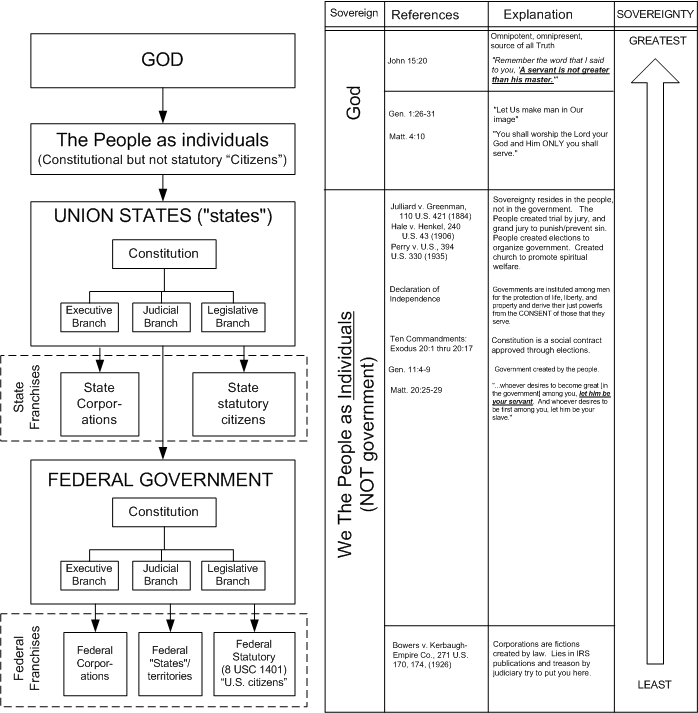
Within American Jurisdprudence, the hierarchy of sovereignty requires that the sequence that things were created and who they were created by establishes the sovereign relations among all things, including both human beings and artificial creations such as corporations and governments. A summary of the hierarchy is below:
- God created the people (as individuals).
- The people (as individual sovereigns) created the state Constitution and the states. The state constitutions divided the state government into three branches: executive, judicial, and legislative. The states also instituted their own internal franchises, including state corporations and state citizens.
- The states created the federal constitution and the federal government. The federal constitution divided the federal government into three branches: executive, judicial, legislative.
- The federal government created federal States, corporations, and privileged “U.S. citizen” status through legislation.
The above hierarchy recognizes nine distinct sovereignties or levels which are completely independent of each other in law. These are:
- God
- The people (as individuals).
- The “states” (of the Union). These states create special franchises underneath them, including:
3.1. State citizenship
3.2. State corporations
- The federal (not national) government. Remember from section 4.6 earlier that the “United States” is not a nation under the law of nations, but a federation, and there is a world of difference. The federal government then creates special franchises underneath them, including:
4.1. Federal Corporations.
4.2. Federal “States”.
4.3. U.S. citizens/idolaters. These are people who have surrendered their sovereignty to the government and choose to be government slaves/serfs/subjects.
The courts have historically recognized the separation of these sovereignties, and all exist by virtue of natural law. Below is a diagram of this hierarchy of sovereignty in graphical form:
Figure 5-1: Sovereignties within our system of government
The rules for how these sovereignties must relate to each other within our system of jurisprudence are as follows, extracted from the rulings of the Supreme Court, federal statutes, the Bible, and historical documents:
- The people are sovereign over all government:
"The ultimate authority...resides in the people alone..."
[James Madison, Federalist Paper No. 46]“Sovereignty itself is, of course, not subject to law, for it is the author and source of law…While sovereign powers are delegated to…the government, sovereignty itself remains with the people.”
[Yick Wo v. Hopkins, 118 U.S. 356 (1886)]“Sovereign state” are cabalistic words, not understood by the disciple of liberty, who has been instructed in our constitutional schools. It is an appropriate phrase when applied to an absolute despotism. I firmly believe, that the idea of sovereign power in the government of a republic, is incompatible with the existence and permanent foundation of civil liberty, and the rights of property. The history of man, in all ages, has shown the necessity of the strongest checks upon power, whether it be exercised by one man, a few or many. Our revolution broke up the foundations of sovereignty in government; and our written constitutions have carefully guarded against the baneful influence of such an idea henceforth and forever. I can not, therefore, recognize the appeal to the sovereignty of the state, as a justification of the act in question. “
[Gaines v. Buford, 31 Ky. (1 Dana) 481, 501] - The people came before the states and created the states. Therefore, they are the Masters and the states are their servants:
“The words 'people of the United States' and 'citizens,' are synonymous terms, and mean the same thing. They both describe the political body who, according to our republican institutions, form the sovereignty, and who hold the power and conduct the government through their representatives. They are what we familiarly call the 'sovereign people,' and every citizen is one of this people, and a constituent member of this sovereignty. ..."
[Boyd v. State of Nebraska, 143 U.S. 135 (1892)] - The states created the federal government and are superior to it. The federal government is the servant to and fiduciary of the states and the states are their Master. This is confirmed by the U.S. Supreme Court in Carter v. Carter Coal Co., 298 U.S. 238 (1936):
The general rule with regard to the respective powers of the national and the state governments under the Constitution is not in doubt. The states were before the Constitution; and, consequently, their legislative powers antedated [and are superior to] the Constitution. Those who framed and those who adopted that instrument meant to carve from the general mass of legislative powers, then possessed by the states, only such portions as it was thought wise to confer upon the federal government; and in order that there should be no uncertainty in respect of what was taken and what was left, the national powers of legislation were not aggregated but enumerated-with the result that what was not embraced by the enumeration remained vested in the states without change or impairment. Thus, 'when it was found necessary to establish a national government for national purposes,' this court said in Munn v. Illinois, 94 U.S. 113 , 124, 'a part of the powers of the States and of the people of the States was granted to the United States and the people of the United States. This grant operated as a further limitation upon the powers of the States, so that now the governments of the States possess all the powers of the Parliament of England, except such as have been delegated to the United States or reserved by the people.' While the states are not sovereign in the true sense of that term, but only quasi sovereign, yet in respect of all powers reserved to them they are supreme-'as independent of the general government as that government within its sphere is independent of the States.' The Collector v. Day, 11 Wall. 113, 124. And since every addition to the national legislative power to some extent detracts from or invades the power of the states, it is of vital moment that, in order to preserve the fixed balance intended by the Constitution, the powers of the general government [298 U.S. 238, 295] be not so extended as to embrace any not within the express terms of the several grants or the implications necessarily to be drawn therefrom. It is no longer open to question that the general government, unlike the states, Hammer v. Dagenhart, 247 U.S. 251, 275 , 38 S.Ct. 529, 3 A.L.R. 649, Ann.Cas.1918E 724, possesses no inherent power in respect of the internal affairs of the states; and emphatically not with regard to legislation. The question in respect of the inherent power of that government as to the external affairs of the Nation and in the field of international law is a wholly different matter which it is not necessary now to consider. See, however, Jones v. United States, 137 U.S. 202, 212 , 11 S.Ct. 80; Nishimur Ekiu v. United States, 142 U.S. 651, 659 , 12 S.Ct. 336; Fong Yue Ting v. United States, 149 U.S. 698 , 705 et seq., 13 S.Ct. 1016; Burnet v. Brooks, 288 U.S. 378, 396 , 53 S.Ct. 457, 86 A.L.R. 747.
The determination of the Framers Convention and the ratifying conventions to preserve complete and unimpaired state self-government in all matters not committed to the general government is one of the plainest facts which emerges from the history of their deliberations. And adherence to that determination is incumbent equally upon the federal government and the states. State powers can neither be appropriated on the one hand nor abdicated on the other. As this court said in Texas v. White, 7 Wall. 700, 725, 'The preservation of the States, and the maintenance of their governments, are as much within the design and care of the Constitution as the preservation of the Union and the maintenance of the National government. The Constitution, in all its provisions, looks to an indestructible Union, composed of indestructible States.' Every journey to a forbidden end begins with the first step; and the danger of such a step by the federal government in the direction of taking over the powers of the states is that the end of the journey may find the states so despoiled of their powers, or-what may amount to the same thing-so [298 U.S. 238, 296] relieved of the responsibilities which possession of the powers necessarily enjoins, as to reduce them to little more than geographical subdivisions of the national domain. It is safe to say that if, when the Constitution was under consideration, it had been thought that any such danger lurked behind its plain words, it would never have been ratified.
And the Constitution itself is in every real sense a law-the lawmakers being the people themselves, in whom under our system all political power and sovereignty primarily resides, and through whom such power and sovereignty primarily speaks. It is by that law, and not otherwise, that the legislative, executive, and judicial agencies which it created exercise such political authority as they have been permitted to possess. The Constitution speaks for itself in terms so plain that to misunderstand their import is not rationally possible. 'We the People of the United States,' it says, 'do ordain and establish this Constitution.' Ordain and establish! These are definite words of enactment, and without more would stamp what follows with the dignity and character of law. The framers of the Constitution, however, were not content to let the matter rest here, but provided explicitly-'This Constitution, and the Laws of the United States which shall be made in Pursuance thereof; ... shall be the supreme Law of the Land.' (Const. art. 6, cl. 2.) The supremacy of the Constitution as law is thus declared without qualification. That supremacy is absolute; the supremacy of a statute enacted by Congress is not absolute but conditioned upon its being made in pursuance of the Constitution. And a judicial tribunal, clothed by that instrument with complete judicial power, and, therefore, by the very nature of the power, required to ascertain and apply the law to the facts in every case or proceeding properly brought for adjudication, must apply the supreme law and reject the inferior stat- [298 U.S. 238, 297] ute whenever the two conflict. In the discharge of that duty, the opinion of the lawmakers that a statute passed by them is valid must be given great weight, Adkins v. Children's Hospital, 261 U.S. 525, 544 , 43 S.Ct. 394, 24 A.L.R. 1238; but their opinion, or the court's opinion, that the statute will prove greatly or generally beneficial is wholly irrelevant to the inquiry. Schechter Poultry Corp. v. United States, 295 U.S. 495, 549 , 550 S., 55 S.Ct. 837, 97 A.L.R. 947.
[Carter v. Carter Coal Co., 298 U.S. 238 (1936)]_________________________________________________________________________________________
“If the time shall ever arrive when, for an object appealing, however strongly, to our sympathies, the dignity of the States shall bow to the dictation of Congress by conforming their legislation thereto, when the power and majesty and honor of those who created shall become subordinate to the thing of their creation, I but feebly utter my apprehensions when I express my firm conviction that we shall see 'the beginning of the end.'”
[Steward Machine Co. v. Davis, 301 U.S. 548 (1937)] - Each sovereign is on an equal footing with every other sovereign: the People, the States, and the Federal Government. Each of these are legal “persons” and each are equal under the law. The rights of one man are equal to the combined rights of ALL men working in either a state or the federal government. This is the essence of equal protection of the laws which is the foundation of our constitution and our republican system of government. We covered this subject in depth earlier in section 4.3.2 if you would like to review.
“No State shall…deny to any person within its jurisdiction the equal protection of the laws. “
[Fourteenth Amendment, Section 1]“The rights of individuals and the justice due to them, are as dear and precious as those of states. Indeed the latter are founded upon the former; and the great end and object of them must be to secure and support the rights of individuals, or else vain is government.”
[Chisholm v. Georgia, 2 U.S. (2 Dall.) 419, 1 L.Ed 440 (1793)]“United States government is as sovereign within its sphere as states are within theirs.”
[Kohl v. United States, 91 U.S. 367, 23 L.Ed. 597 (1876)] - No sovereign can serve more than one master above it. By implication, this means that no sovereign can have more than one creator:
“No servant can serve two masters; for either he will hate the one and love the other, or else he will be loyal to the one and despise the other. You cannot serve God and mammon.”
[Jesus [God] speaking in the Bible, Luke 16:13]_______________________________________________________________________________
TITLE 18 > PART I > CHAPTER 11 > §208
§208. Acts affecting a personal financial interest(a)Except as permitted by subsection (b) hereof, whoever, being an officer or employee of the executive branch of the United States Government, or of any independent agency of the United States, a Federal Reserve bank director, officer, or employee, or an officer or employee of the District of Columbia, including a special Government employee, participates personally and substantially as a Government officer or employee, through decision, approval, disapproval, recommendation, the rendering of advice, investigation, or otherwise, in a judicial or other proceeding, application, request for a ruling or other determination, contract, claim, controversy, charge, accusation, arrest, or other particular matter in which, to his knowledge, he, his spouse, minor child, general partner, organization in which he is serving as officer, director, trustee, general partner or employee, or any person or organization with whom he is negotiating or has any arrangement concerning prospective employment, has a financial interest—
Shall be subject to the penalties set forth in section 216 of this title.
- The main and only purpose of the separation of sovereignties and powers within sovereignties in the above diagram is to protect the individual liberties of the ultimate sovereigns, the people (as individuals) themselves. See U.S. v. Lopez, 514 U.S. 549 (1995):
We start with first principles. The Constitution creates a Federal Government of enumerated powers. See U.S. Const., Art. I, 8. As James Madison wrote, "[t]he powers delegated by the proposed Constitution to the federal government are few and defined. Those which are to remain in the State governments are numerous and indefinite." The Federalist No. 45, pp. 292-293 (C. Rossiter ed. 1961). This constitutionally mandated division of authority "was adopted by the Framers to ensure protection of our fundamental liberties." Gregory v. Ashcroft, 501 U.S. 452, 458 (1991) (internal quotation marks omitted). "Just as the separation and independence of the coordinate branches of the Federal Government serves to prevent the accumulation of excessive power in any one branch, a healthy balance of power between the States and the Federal Government will reduce the risk of tyranny and abuse from either front."
[U.S. v. Lopez, 514 U.S. 549 (1995)] - A sovereignty is a servant or fiduciary of all sovereignties above it and a master over all those below it. For instance, the states created the federal government so they are sovereign over it and may change it at any time by amending the constitution that created it, or by abolishing it entirely.
“A State does not owe its origin to the Government of the United States, in the highest or in any of its branches. It was in existence before it. It derives its authority from the same pure and sacred source as itself: The voluntary and deliberate choice of the people…A State is altogether exempt from the jurisdiction of the Courts of the United States, or from any other exterior authority, unless in the special instances when the general Government has power derived from the Constitution itself.”
[Chisholm v. Georgia, 2 Dall. (U.S.) 419 (Dall.) (1794)] - Delegated authority:
8.1. A sovereign can only exercise those powers specifically delegated to it in a written constitution. Any other action is specifically forbidden or reserved by implication to the master it serves. For instance, the Tenth Amendment reserves police powers to the states. All powers not specifically given to the federal government in the federal constitution are therefore reserved to the states or to the people under the Tenth Amendment:
"The Government of the United States is one of delegated powers alone. Its authority is defined and limited by the Constitution. All powers not granted to it by that instrument are reserved to the States or the people."
[United States v. Cruikshank, 92 U.S. 542 (1875)]"By the tenth amendment, 'the powers not delegated to the United States by the constitution, nor prohibited by it to the states, are reserved to the states, respectively, or to the people.' Among the powers thus reserved to the several states is what is commonly called the 'police power,'-that inherent and necessary power, essential to the very existence of civil society, and the safeguard of the inhabitants of the state against disorder, disease, poverty, and crime. 'The police power belonging to the states in virtue of their general sovereignty,' said Mr. Justice STORY, delivering the judgment of this court, 'extends over all subjects within the territorial limits of the states, and has never been conceded to the United States.' Prigg v. Pennsylvania, 16 Pet. 539, 625. This is well illustrated by the recent adjudications that a statute prohibiting the sale of illuminating oils below a certain fire test is beyond the constitutional power of congress to enact, except so far as it has effect within the United States (as, for instance, in the District of Columbia) and without the limits of any state; but that it is within the constitutional power of a state to pass such a statute, even as to oils manufactured under letters patent from the United States. U. S. v. Dewitt, 9 Wall. 41; Patterson v. Kentucky, 97 U.S. 501 . [135 U.S. 100, 128] The police power includes all measures for the protection of the life, the health, the property, and the welfare of the inhabitants, and for the promotion of good order and the public morals. It covers the suppression of nuisances, whether injurious to the public health, like unwholesome trades, or to the public morals, like gambling-houses and lottery tickets. Slaughter-House Cases, 16 Wall. 36, 62, 87; Fertilizing Co. v. Hyde Park, 97 U.S. 659 ; Phalen v. Virginia, 8 How. 163, 168; Stone v. Mississippi, 101 U.S. 814 . This power, being essential to the maintenance of the authority of local government, and to the safety and welfare of the people, is inalienable. As was said by Chief Justice WAITE, referring to earlier decisions to the same effect: 'No legislature can bargain away the public health or the public morals. The people themselves cannot do it, much less their servants. The supervision of both these subjects of governmental power is continuing in its nature, and they are to be dealt with as the special exigencies of the moment may require. Government is organized with a view to their preservation, and cannot divest itself of the power to provide for them. For this purpose the largest legislative discretion is allowed, and the discretion cannot be parted with any more than the power itself.' Stone v. Mississippi, 101 U.S. 814 , 819. See, also, Butchers' Union, etc., Co. v. Crescent City, etc., Co., 111 U.S. 746, 753 , 4 S. Sup. Ct. Rep. 652; New Orleans Gas Co. v Louisiana Light Co., 115 U.S. 650, 672 , 6 S. Sup. Ct. Rep. 252; New Orleans v. Houston, 119 U.S. 265, 275 , 7 S. Sup. Ct. Rep. 198.”
[Leisy v. Hardin, 135 U.S. 100 (1890)]8.2. Agents or fiduciaries within a sovereign must be willing and able at all times to identify the specific laws that give them the authority to act and be constantly aware of the limits of their delegated authority. If they are not, they run the risk of exceeding their delegated authority and injuring the rights of the master(s) they serve. All actions not specifically authorized by law are illegal by implication. All illegal actions by government officials that are outside their written delegated authority that result in an injury to the master(s) cause the actor to be personally liable for a tort and monetary damages because they are acting outside the authority of law.
“Unlawful. That which is contrary to, prohibited, or unauthorized by law. That which is not lawful. The acting contrary to, or in defiance of the law; disobeying or disregarding the law. Term is equivalent to “without excuse or justification.” State v. Noble, 90 N.M. 360, 563 P.2d 1153, 1157. While necessarily not implying the element of criminality, it is broad enough to include it.”
[Black’s Law Dictionary, Sixth Edition, p. 1536]8.3 A sovereignty or human being cannot delegate an authority to a subordinate that they themselves do not ALSO possess.
“Quod meum est sine me auferri non potest.[1]
What is mine [sovereignty in this case] cannot be taken away without my consent”
[Bouvier’s Law Dictionary Unabridged, 8th Edition, pg. 2159]“Derivativa potestas non potest esse major primitive.[2]
The power [sovereign immunity in this case] which is derived cannot be greater than that from which it is derived.”
[Bouvier’s Law Dictionary Unabridged, 8th Edition, pg. 2131]“Nemo potest facere per obliquum quod non potest facere per directum.[3]
No one can do that indirectly which cannot be done directly.”
[Bouvier’s Law Dictionary Unabridged, 8th Edition, pg. 2147]“Quod per me non possum, nec per alium..[4]
What I cannot do in person, I cannot do through the agency of another.”
[Bouvier’s Law Dictionary Unabridged, 8th Edition, pg. 2159]
[1] Jenk. Cent. 251.
[2] Wing. Max. 36: Pinch. Law, b. 1. c. 3, p. 11.
[3] 1 Eden 512
[4] 4 Co. 24 b: 11 id. 87 a.
[SOURCE: http://famguardian.org/Publications/BouvierMaximsOfLaw/BouviersMaxims.htm]
8.4. No sovereign can delegate to its fiduciaries the authority to do something that is a crime. For instance, if the people cannot murder, rob, or steal from their fellow man, then they certainly cannot delegate that authority to government, which means they cannot delegate to the government the authority to collect direct taxes upon individuals unless the persons paying the tax voluntarily consent to it individually, otherwise it is theft.
"In Calder v. Bull, which was here in 1798, Mr. Justice Chase said, that there were acts which the Federal and State legislatures could not do without exceeding their authority, and among them he mentioned a law which punished a citizen for an innocent act; a law that destroyed or impaired the lawful private [labor] contracts [and labor compensation, e.g. earnings from employment through compelled W-4 withholding] of citizens; a law that made a man judge in his own case; and a law that took the property from A [the worker]. and gave it to B [the government or another citizen, such as through social welfare programs]. 'It is against all reason and justice,' he added, 'for a people to intrust a legislature with such powers, and therefore it cannot be presumed that they have done it. They may command what is right and prohibit what is wrong; but they cannot change innocence [a “nontaxpayer”] into guilt [a “taxpayer”, by presumption or otherwise], or punish innocence as a crime, or violate the right of an antecedent lawful private [employment] contract [by compelling W-4 withholding, for instance], or the right of private property. To maintain that a Federal or State legislature possesses such powers [of THEFT!] if they had not been expressly restrained, would, in my opinion, be a political heresy altogether inadmissible in all free republican governments.' 3 Dall. 388."
[Sinking Fund Cases, 99 U.S. 700 (1878)] - The Constitution is a trust document and creates a public trust. Public officers are the “trustees” within that trust and when they abuse their authority, they are executing a “sham trust” for their own personal gain. It is a violation of fiduciary duty for a sovereign or any agent within a sovereign to put a higher priority over its own needs than over any of the masters it serves above it. This is called a conflict of interest and it is against the law. See for instance 18 U.S.C. §208.
"Whatever these Constitutions and laws validly determine to be property, it is the duty of the Federal Government, through the domain of jurisdiction merely Federal, to recognize to be property.
“And this principle follows from the structure of the respective Governments, State and Federal, and their reciprocal relations. They are different agents and trustees of the people of the several States, appointed with different powers and with distinct purposes, but whose acts, within the scope of their respective jurisdictions, are mutually obligatory. "
[Dred Scott v. Sandford, 60 U.S. 393 (1856)] - Sovereign Immunity: A government sovereign is exempt from the jurisdiction of the courts of any other government sovereign unless it consents to the jurisdiction of the other sovereign or unless the Constitution that established it makes it subject to the jurisdiction in question. This is called sovereign immunity and it is the embodiment of the separation of powers doctrine. The rules for surrendering sovereign immunity through consent are documented in 28 U.S.C. §1605. Here is an example of sovereign immunity of states from the U.S. Supreme Court:
“A State does not owe its origin to the Government of the United States, in the highest or in any of its branches. It was in existence before it. It derives its authority from the same pure and sacred source as itself: The voluntary and deliberate choice of the people…A State is altogether exempt from the jurisdiction of the Courts of the United States, or from any other exterior authority, unless in the special instances when the general Government has power derived from the Constitution itself.”
[Chisholm v. Georgia, 2 Dall. (U.S.) 419 (Dall.) (1794)] - Sovereign immunity also extends to all entities or corporations created by a government sovereign. For instance, the case of Providence Bank v. Billings, 29 U.S. 514 (1830) revealed that the states could not tax a bank corporation created by an act or law of the United States government. The reasoning in that case was that the states could not destroy the federal government because the power to tax necessarily involved the power to destroy.
“The great principle is this: because the constitution will not permit a state to destroy, it will not permit a law involving the power to destroy. In order to show that the case turned entirely on that point, let us suppose that the court had arrived to the conclusion that the bank [The Bank of the United States located in the state of Maryland] was an authorised instrument of government; but that it was not the intention of the constitution to prohibit the states from interfering with those instruments: would it not have been necessary to have decided that the Maryland act was constitutional? Of what importance was it that the bank was an authorized means of power, other than this, that it afforded a key to the meaning of the constitution? If the bank was a legitimate and proper instrument of power, then the constitution intended to protect it. If not, then no protection was intended. The question, whether it was a necessary and proper means, was auxiliary to the great question, whether the constitution intended to shelter it; and when the court arrived to the conclusion that such protection was intended, they interfered not in behalf of the bank, but in behalf of the sanctuary to which it had fled. They decided against the tax; because the subject had been placed beyond the power of the states, by the constitution. They decided, not on account of the subject, but on account of the power that protected it; they decided that a prohibition against destruction was a prohibition against a law involving the power of destruction.”
[Providence Bank v. Billings, 29 U.S. 514 (1830)] - A sovereignty may not tax or regulate or control its creator or grantor, or any sovereignty or agent of that sovereignty above it or at the same level as it, without the explicit and individual consent of that sovereign.
12.1. For instance, because churches are agents of God, then government may not tax churches, and this applies whether or not such churches have a 501(c ) designation or not. See Isaiah 45:9-10:
“Woe to him who strives with his Maker! Let the potsherd strive with the potsherds of the earth! Shall the clay say to him who forms it, ‘What are you making?’ Or shall your handiwork say, ‘He has no hands?’ Who to him who says to his father, ‘What are you begetting?’ Or to the woman, ‘What have you brought forth?’”
[Isaiah 45:9-10, Bible, NKJV]12.2. Below is a U.S. Supreme Court cite which admits that in many cases, even the U.S. Supreme Court may not compel states:
“This court has declined to take jurisdiction of suits between states to compel the performance of obligations which, if the states had been independent nations, could not have been enforced judicially, but only through the political departments of their governments. Thus, in Kentucky v. Dennison, 24 How. 66, where the state of Kentucky, by her governor [127 U.S. 265, 289] applied to this court, in the exercise of its original jurisdiction, for a writ of mandamus to the governor of Ohio to compel him to surrender a fugitive from justice, this court, while holding that the case was a controversy between two states, decided that it had no authority to grant the writ.”
[State of Wisconsin v. Pelican Insurance Company, 127 U.S. 265 (1888)]12.3. Here is an example from the Supreme Court where it is admitted that a state may not be taxed by the federal government:
“In Morcantile Bank v. City of New York, 121 U.S. 138, 162 , 7 S. Sup. Ct. 826, this court said: 'Bonds issued by the state of New York, or under its authority, by its public municipal bodies, are means for carrying on the work of the government, and are not taxable, even by the United States, and it is not a part of the policy of the government which issues them to subject them to taxation for its own purposes.'”
[Pollock v. Farmers Loan and Trust, 157 U.S. 429 (1895)]12.4. Here is an example where the Supreme Court said that states may not tax each other’s bonds:
“The question in Bonaparte v. Tax Court, 104 U.S. 592 , was whether the registered public debt of one state, exempt from taxation by that state, or actually taxed there, was taxable by another state, when owned by a citizen of the latter, and it was held that there was no provision of the constitution of the United States which prohibited such taxation. The states had not covenanted that this could not be done, whereas, under the fundamental law, as to the power to borrow money, neither the United States, on the one hand, nor the states on the other, can interfere with that power as possessed by each, and an essential element of the sovereignty of each. “
[Pollock v. Farmers Loan and Trust, 157 U.S. 429 (1895)]12.5 The Supreme Court also said that states may not tax the federal government:
“While the power of taxation is one of vital importance, retained by the states, not abridged by the grant of a similar power to the government of the Union, but to be concurrently exercised by the two governments, yet even this power of a state is subordinate to, and may be controlled by, the constitution of the United States. That constitution and the laws made in pursuance thereof are supreme. They control the constitutions and laws of the respective states, and cannot be controlled by them. The people of a state give to their government a right of taxing themselves and their property at its discretion. But the means employed by the government of the Union are not given by the people of a particular state, but by the people of all the states; and being given by all, for the benefit of all, should be subjected to that government only which belongs to all. All subjects over which the sovereign power of a state extends are objects of taxation; but those over which in does not extend are, upon the soundest principles, exempt from taxation. The sovereignty of a state extends to everything which exists by its own authority, or is introduced by its permission; but does not extend to those means which are employed by congress to carry into execution powers conferred on that body by the people of the United States. The attempt to use the taxing power of a state on the means employed by the government of the Union, in pursuance of the constitution, is itself an abuse, because it is the usurpation of a power which the people of a single state cannot give. The power to tax in volves the power to destroy; the power to destroy may defeat and render useless the power to create; and there is a plain repugnance in conferring on one government a power to control the constitutional measures of another, which other, with respect to those very measures, is declared to be supreme over that which exerts the control. The states have no power, by taxation [117 U.S. 151, 156] or otherwise, to retard, impede, burden, or in any manner control, the operations of the constitutional laws enacted by congress to carry into execution the powers vested in the general government. Such are the outlines, mostly in his own words, of the grounds of the judgment delivered by Chief Justice MARSHALL in the great case of McCulloch v. Maryland, in which it was decided that a statute of the state of Maryland, imposing a tax upon the issue of bills by banks, could not constitutionally be applied to a branch of the Bank of the United States within that state. 4 Wheat. 316, 425-431, 436.
“In Osborn v. Bank of U. S., 9 Wheat. 738, 859-868, that conclusion was reviewed in a very able argument of counsel, and reaffirmed by the court, and a tax laid by the state of Ohio upon a branch of the Bank of the United States was held to be unconstitutional. See, also, Providence Bank v. Billings, 4 Pet. 514, 564. Upon the same grounds, the states have been adjudged to have no power to lay a tax upon stock issued for money borrowed by the United States, or upon property of state banks invested in United States stock. Weston v. City Council of Charleston, 2 Pet. 449, 467; Bank of Commerce v. New York, 2 Black, 620; Bank Tax Case, 2 Wall. 200; Banks v. Mayor, 7 Wall. 16.”
[Van Brocklin v. State of Tennessee, 117 U.S. 151 (1886)]12.6. Finally, the federal government may not tax the employees of states of the union:
“As stated by Judge [157 U.S. 429, 602] Cooley in his work on the Principles of Constitutional Law: 'The power to tax, whether by the United States or by the states, is to be construed in the light of and limited by the fact that the states and the Union are inseparable, and that the constitution contemplates the perpetual maintenance of each with all its constitutional powers, unembarrassed and unimpaired by any action of the other. The taxing power of the federal government does not therefore extend to the means or agencies through or by the employment of which the states perform their essential functions; since, if these were within its reach, they might be embarrassed, and perhaps wholly paralyzed, by the burdens it should impose. 'That the power to tax involves the power to destroy; that the power to destroy may defeat and render useless the power to create; that there is a plain repugnance in conferring on one government a power to control the constitutional measures of another, which other, in respect to those very measures, is declared to be supreme over that which exerts the control,-are propositions not to be denied.' It is true that taxation does not necessarily and unavoidably destroy, and that to carry it to the excess of destruction would be an abuse not to be anticipated; but the very power would take from the states a portion of their intended liberty of independent action within the sphere of their powers, and would constitute to the state a perpetual danger of embarrassment and possible annihilation. The constitution contemplates no such shackles upon state powers, and by implication forbids them.'”
[Pollock v. Farmers Loan and Trust, 157 U.S. 429 (1895)] - A sovereignty may tax or regulate any of the entities or sovereignties below it, because it created those subordinate sovereignties. The power to create carries with it the power to destroy as well. See M'Culloch v. Maryland, 4 Wheat. 316, 431 (1819). Specific examples of sovereignties taxing their fiduciaries below include:
13.1. State taxation within federal enclaves under the Buck Act, found in 4. U.S.C. §§105-111
13.2. State and federal taxation of corporations. See 26 U.S.C. Subtitles D and E and Flint v. Stone Tracy, 220 U.S. 107 (1911).
13.3. A sovereign may only tax the entities that it creates. The U.S. Supreme Court case of U.S. v. Perkins, 163 U.S. 625 (1896) reveals, for instance, that states can only tax corporations that they create.
“Whether the United States are a corporation 'exempt by law from taxation,' within the meaning of the New York statutes, is the remaining question in the case. The court of appeals has held that this exemption was applicable only to domestic corporations declared by the laws of New York to be exempt from taxation. Thus, in Re Prime's Estate, 136 N. Y. 347, 32 N. E. 1091, it was held that foreign religious and charitable corporations were not exempt from the payment of a legacy tax, Chief Judge Andrews observing (page 360, 136 N. Y., and page 1091, 32 N. E.): 'We are of opinion that a statute of a state granting powers and privileges to corporations must, in the absence of plain indications to the contrary, be held to apply only to corporations created by the state, and over which it has power of visitation and control. ... The legislature in such cases is dealing with its own creations, whose rights and obligations it may limit, define, and control.' To the same effect are Catlin v. Trustees, 113 N. Y. 133, 20 N.E. 864; White v. Howard, 46 N. Y. 144; In re Balleis' Estate, 144 N. Y. 132, 38 N. E. 1007; Minot v. Winthrop, 162 Mass. 113, 38 N. E. 512; Dos P. Inh. Tax Law, c. 3, 34. If the ruling of the court of appeals of New York in this particular case be not absolutely binding upon us, we think that, having regard to the purpose of the law to impose a tax generally upon inheritances, the legislature intended to allow an exemption only in favor of such corporations as it had itself created, and which might reasonably be supposed to be the special objects of its solicitude and bounty.
“In addition to this, however, the United States are not one of the class of corporations intended by law to be exempt [163 U.S. 625, 631] from taxation. What the corporations are to which the exemption was intended to apply are indicated by the tax laws of New York, and are confined to those of a religious, educational, charitable, or reformatory purpose. We think it was not intended to apply it to a purely political or governmental corporation, like the United States. Catlin v. Trustees, 113 N. Y. 133, 20 N. E. 864; In re Van Kleeck, 121 N. Y. 701, 75 N. E. 50; Dos P. Inh. Tax Law, c. 3, 34. In Re Hamilton, 148 N. Y. 310, 42 N. E. 717, it was held that the execution did not apply to a municipality, even though created by the state itself.”
[U.S. v. Perkins, 163 U.S. 625 (1896)] - The jurisdiction of each government sovereignty is divided into territorial and subject matter jurisdiction:
14.1. Government sovereigns have exclusive and absolute jurisdiction, sometimes called “plenary power” or "general jurisdiction", over their own territory, and no other sovereignty can exercise jurisdiction over this territory without the consent of the sovereign manifested in some form, and usually by an act of the legislature:
“The jurisdiction of the nation within its own territory is [169 U.S. 649, 684] necessarily exclusive and absolute. It is susceptible of no limitation not imposed by itself. Any restriction upon it, deriving validity from an external source, would imply a diminution of its sovereignty to the extent of the restriction, and an investment of that sovereignty to the same extent in that power which could impose such restriction. All exceptions, therefore, to the full and complete power of a nation within its own territories, must be traced up to the consent of the nation itself. They can flow from no other legitimate source. This consent may be either express or implied. In the latter case, it is less determinate, exposed more to the uncertainties of construction; but, if understood, not less obligatory.”
[The Exchange, 7 Cranch 116 (1812)]________________________________________________
"Territory: A part of a country separated from the rest, and subject to a particular jurisdiction. Geographical area under the jurisdiction of another country or sovereign power.
A portion of the United States not within the limits of any state, which has not yet been admitted as a state of the Union, but is organized with a separate legislature, and with executive and judicial powers appointed by the President."
[Black's Law Dictionary, Sixth Edition, p. 1473]The requirement for explicit consent is called “comity” in the legal field:
“comity. Courtesy; complaisance; respect; a willingness to grant a privilege, not as a matter of right, but out of deference and good will. Recognition that one sovereignty allows within its territory to the legislative, executive, or judicial act of another sovereignty, having due regard to rights of its own citizens. Nowell v. Nowell, Tex.Civ.App., 408 S.W.2d 550, 553. In general, principle of "comity" is that courts of one state or jurisdiction will give effect to laws and judicial decisions of another state or jurisdiction, not as a matter of obligation, but out of deference and mutual respect. Brown v. Babbitt Ford, Inc., 117 Ariz. 192, 571 P.2d 689, 695. See also Full faith and credit clause.”
[Black’s Law Dictionary, Sixth Edition, p. 267]14.2. States of the union have territorial jurisdiction within their respective borders over all land not ceded by an act of the legislature of the state to the federal government. They have no jurisdiction outside of their borders.
14.3. The federal government has legislative territorial jurisdiction only over: 1. The federal zone; 2. All areas or enclaves within the union states that have been ceded to it by an act of the state legislature under Article 1, Section 8, Clause 17 of the Constitution; 3. Its own territories, possessions, and property, wherever situated; 4. Its own domiciliaries, which includes citizens and residents. Under most circumstances, the federal government has no legislative jurisdiction within states of the Union because the federal constitution reserves “police powers” to the states under the Tenth Amendment.
14.4. Within states of the Union, the only type of jurisdiction the federal government can have over areas that are not its territory is subject matter jurisdiction and that jurisdiction must be explicitly identified in the federal Constitution in order to exist at all. There are very few issues over which the federal government has subject matter jurisdiction and income taxes under Subtitles A through C of the Internal Revenue Code is an example of an area where such jurisdiction does not exist. Covetous public dis-servants have systematically tried to hide this fact over the years by obfuscating the Internal Revenue Code and using illegal IRS extortion to coerce federal judges into violating the Constitutional rights of Americans in the states. Subject matter jurisdiction within states of the Union is limited to the following subjects and no others:
14.4.1. Foreign and interstate commerce. See Constitution, Article 1, Section 8, Clause 3. This includes the following subjects:
14.4.1.1. Taxes on importation, but not exportation. See 26 U.S.C. §7001 and U.S. Constitution, Article 1, Section 9, Clause 3.
14.4.1.2. Claims arising out of bankruptcy proceedings. See 28 U.S.C. §1334; Pauletto v. Reliance Ins. Co., 64 CA.4th 597 (1998), 602, 75 CR.2d 334, 337 --state courts lack jurisdiction in action for malicious prosecution based on defendant's having filed adversary proceeding in bankruptcy court: "it is for Congress and the federal courts, not state courts, to decide what incentives and penalties shall be utilized in the bankruptcy process".
14.4.1.3. Claims under Sherman Antitrust Act. See 15 U.S.C. §4.
14.4.1.4. Claims under Securities Exchange Act of 1934 (including Rule 10b-5 actions). See 15 U.S.C. §78aa
14.4.1.5. Claims involving activities regulated by federal labor laws. E.g., the Labor Management Reporting and Disclosure Act (19 U.S.C. §401 et seq.) preempts state power to adjudicate claims based on union contracts or union activities, unless of "merely peripheral concern" to the Act. See San Diego Bldg. Trades Council, etc. v. Garmon, 359 U.S. 236 (1959), 247-248, 79 S.Ct. 773, 781-782; Bassett v. Attebery, 180 CA.3d 288 (1986), 294-295, 224 CR 399, 402—NLRB (rather than federal court) has exclusive jurisdiction over wrongful discharge claim alleging violation of federal labor laws]
14.4.1.6. Certain ERISA actions: Suits for injunctive or other equitable relief against an employer or insurer under the Employee Retirement Income Security Act (ERISA) (But federal and state courts have concurrent jurisdiction of claims for benefits due.). See 29 U.S.C. §1132(e)(1)
14.4.2. Federal property and “employees”. See Constitution Article 4, Section 3, Clause 2.
14.4.3. Frauds involving the mail. See Constitution, Article 1, Section 8, Clause 7.
14.4.4. Treason. See Constitution, Article 4, Section 2, Clause 2.
14.4.5. Patent and copyright claims. See 28 U.S.C. §1338(a) and Constitution, Article 1, Section 8, Clause 8.
14.4.6. Admiralty and maritime claims. See 28 U.S.C. §1333 and Constitution Article 1, Section 8, Clause 10.
14.5 The formation of a state within territory under the exclusive control of the federal government does not affect the legal status of property not within the territory of the new state:
“’This provision authorizes the United States to be and become a land-owner, and prescribes the mode in which the lands may be disposed of, and the title conveyed to the purchaser. Congress is to make the needful rules and regulations upon this subject. The title of the United States can be divested by no other power, by no other means, in no other mode, than that which congress shall sanction and prescribe. It cannot be done by the action of the people or legislature of a territory or state.' And he supported this conclusion by a review of all the acts of congress under which states had theretofore been admitted. Mr. Webster said that those precedents demonstrated that 'the general idea has been, in the creation of a state, that its admission as a state has no effect at all on the property of the United States lying within its limits;' and that it was settled by the judgment of this court in Pollard v. Hagan, 3 How. 212, 224, 'that the authority of the United States does so far extend as, by force of itself, Proprio vigore, to exempt the public lands from taxation when new states are created in the territory in which the lands lie.' 21 Cong. Globe, 31st Cong. 1st Sess. p. 1314; 22 Cong. Globe, pp. 848 et seq., 960, 986, 1004; 5 Webst. Works, 395, 396, 405.”
[Van Brocklin v. State of Tennessee, 117 U.S. 151 (1886)] - Jurisdiction of each government sovereignty over subjects or sovereignties underneath it is created by oath of allegiance, which we will discuss later in section 5.2.1.
15.1. In order to preserve their sovereignty, the people at the top of this hierarchy should not swear an oath of allegiance to any government, because by doing so, they come under the jurisdiction of the laws of that government and have to surrender their sovereignty. See section 5.2.1 for further details and also see Matt. 5:33-37, which says that Christians should not swear an oath to anything.
15.2. Each officer of both the state and federal governments takes an oath of allegiance to support and defend the Constitution of the United States against all enemies, foreign and domestic. Failure to live up to that oath amounts to perjury of one’s oath, which can result in removal from office.
15.3. If is a violation of the separation of powers doctrine and a conflict of interest to take oaths to TWO masters or to occupy a public office that requires an oath to two different masters or sovereignties. Hence, it is a violation of the Constitutions of most states to simultaneously serve in a public office in the state government as well as the federal government.
CALIFORNIA CONSTITUTION
ARTICLE 7 PUBLIC OFFICERS AND EMPLOYEESSEC. 7. A person holding a lucrative office under the United States or other power may not hold a civil office of profit [within the state government]. A local officer or postmaster whose compensation does not exceed 500 dollars per year or an officer in the militia or a member of a reserve component of the armed forces of the United States except where on active federal duty for more than 30 days in any year is not a holder of a lucrative office, nor is the holding of a civil office of profit affected by this military service.
- Any legislation or ruling by the judicial branch of either a state government or the federal government that breaks down the distinct separation of the powers above is unconstitutional and violates Article 4, Section 4 of the federal constitution, which requires that:
United States Constitution, Article 4, Section 4
“The United States shall guarantee to every State in this Union a Republican Form of Government, and shall protect each of them against Invasion; and on Application of the Legislature, or of the Executive (when the Legislature cannot be convened) against domestic Violence.”
A republican form of government is based on individual, not collective rights, and those rights cannot be defended or protected from federal “invasion” or encroachment without separation of powers to the maximum extent possible. This concept is called the “Separation of Powers Doctrine”. The implications of this requirement include:
16.1. Federal government may not offer franchises to states of the Union. Only federal “States” defined in 4 U.S.C. §110(d) can be party to federal franchises.
16.2. Federal government may not offer franchises, licenses, or privileges to anyone domiciled in a sovereign state of the Union and protected by the Constitution. Another way of saying this is that those who took an oath to support and defend your rights cannot make a business out of enticing you into surrendering them in exchange for anything, whether real or perceived.
16.3. State governments may not offer franchises, licenses, or privileges to domiciled within the state whose domicile is not on federal territory. Another way of saying this is that those who took an oath to support and defend your rights cannot make a business out of enticing you into surrendering them in exchange for anything, whether real or perceived.
If you would like to know more about the abuse of franchises by malicious public servants to destroy the separation of powers and enslave the people, read:
Government Instituted Slavery Using Franchises, Form #05.030
http://sedm.org/Forms/FormIndex.htm - A sovereignty that wants to influence or control a subordinate sovereignty that is not immediately underneath it must do so by using the sovereignty below it as its conduit or agent.
- In the realm of commerce, both state and federal sovereignties are treated just like any natural person and recovery of debts is accomplished within courts of equity.
“…when the United States enters into commercial business it abandons its sovereign capacity and is treated like any other corporation…”
[91 Corpus Juris Secundum, United States, §4] - Human beings domiciled inside the federal zone above do not fall into the category of “The People” because the federal zone is not a constitutional republic, but a totalitarian socialist democracy. They ARE NOT parties to the Constitution and therefore are not protected by it. See section 4.8 earlier for further clarification on this subject. “The People” referred to in the diagram instead are those natural persons residing in and born within the 50 union states who claim their correct status as either “state nationals” or “nationals” as described in 8 U.S.C. §1101(a)(22)(B) and 8 U.S.C. §1101(a)(21) . Persons who claim to be “U.S. citizens” or who are in receipt of government privileges as elected or appointed officers of the government have also forfeited their sovereignty and their position in the above diagram to fall at the same level as corporations and federal “States”.
“Indeed, the practical interpretation put by Congress upon the Constitution has been long continued and uniform to the effect [182 U.S. 244, 279] that the Constitution is applicable to territories acquired by purchase or conquest, only when and so far as Congress shall so direct. Notwithstanding its duty to 'guarantee to every state in this Union a republican form of government' (art. 4, 4), by which we understand, according to the definition of Webster, 'a government in which the supreme power resides in the whole body of the people, and is exercised by representatives elected by them,' Congress did not hesitate, in the original organization of the territories of Louisiana, Florida, the Northwest Territory, and its subdivisions of Ohio, Indiana, Michigan, Illinois, and Wisconsin and still more recently in the case of Alaska, to establish a form of government bearing a much greater analogy to a British Crown colony than a republican state of America, and to vest the legislative power either in a governor and council, or a governor and judges, to be appointed by the President. It was not until they had attained a certain population that power was given them to organize a legislature by vote of the people. In all these cases, as well as in territories subsequently organized west of the Mississippi, Congress thought it necessary either to extend to Constitution and laws of the United States over them, or to declare that the inhabitants should be entitled to enjoy the right of trial by jury, of bail, and of the privilege of the writ of habeas corpus, as well as other privileges of the bill of rights.”
[Downes v. Bidwell, 182 U.S. 244 (1901)] - A state sovereignty cannot consent to the enlargement of the powers of Congress or of any other subordinate sovereignty beyond those clearly enumerated in the Constitution.
“State officials thus cannot consent to the enlargement of the powers of Congress beyond those enumerated in the Constitution.”
[New York v. United States, 505 U.S. 142; 112 S.Ct. 2408; 120 L.Ed.2d 120 (1992)] - A “national” or a “state national” or a "foreign national" may not sue any state government in a federal court. He can only do so in a court of the state that he is suing. This is because the servant, which is the Federal Government, cannot be greater than its master and creator, the states of the Union. See the Eleventh Amendment, which says:
“The Judicial power of the United States shall not be construed to extend to any suit in law or equity, commenced or prosecuted against one of the United States by Citizens of another State, or by Citizens or Subjects of any Foreign State.”
- A sovereignty may, under the rules of comity, voluntarily relinquish a portion of its sovereignty to a sovereignty below it but not above it. For example, under the Buck Act, 4 U.S.C. §§105-111, the U.S. government gave jurisdiction to “States”, which in fact are territories of the federal United States (within the U.S. Code), to enforce their tax laws within federal areas or enclaves located within their exterior boundaries. Many people mistakenly believe that this act gave the same type of authority to states of the Union, but the definition of “State” found in 4 U.S.C. §110(d) confirms that such a “State” is either a territory or possession of the United States, as defined in Title 48 of the U.S. Code. The reason that the federal government cannot consent to the enlargement of powers of states of the Union within its borders is that this would violate the separation of powers doctrine and undermine the obligation of Article 4, Section 4 of the Constitution, which requires Congress to guarantee a “Republican form of government”. Below is the statute that authorizes territories and possessions of the United States to enforce their tax laws within federal enclaves:
TITLE 4 > CHAPTER 4 > Sec. 106.
Sec. 106. - Same; income tax(a) No person shall be relieved from liability for any income tax levied by any State, or by any duly constituted taxing authority therein, having jurisdiction to levy such a tax, by reason of his residing within a Federal area or receiving income from transactions occurring or services performed in such area; and such State or taxing authority shall have full jurisdiction and power to levy and collect such tax in any Federal area within such State to the same extent and with the same effect as though such area was not a Federal area.
(b) The provisions of subsection (a) shall be applicable only with respect to income or receipts received after December 31, 1940
-
The CREATOR of a thing is the ONLY one who has the power to DEFINE exactly what it means. You should NEVER give the power to define ANYTHING you put on a government form in the hands of a government worker, because they will ALWAYS define it to place you under their jurisdiction and benefit themselves personally. That means you should NEVER submit any government form without defining ANY and EVERY possible “word of art” on the form so that you will not waive any rights or benefit them.
“But when Congress creates a statutory right [a “privilege” in this case, such as a “trade or business”], it clearly has the discretion, in defining that right, to create presumptions, or assign burdens of proof, or prescribe remedies; it may also provide that persons seeking to vindicate that right must do so before particularized tribunals created to perform the specialized adjudicative tasks related to that right.”
This is VERY important to know, because although Congress CREATES franchises and OFFERS you opportunities to sign up and thereby waive your Constitutional rights, YOU and ONLY YOU have the right to DEFINE all terms on the application to join the franchise. Most such applications are signed under penalty of perjury and constitute testimony of a witness, and therefore it is a criminal offense to threaten or tamper with or advise the submitter to fill out the form in a certain way or else criminal witness tampering has occurred. That means that if you are compelled to sign up for the franchise against your will, you can define all terms on the form so as to:
[Northern Pipeline Const. Co. v. Marathon Pipe Line Co., 458 U.S. 50, 102 S.Ct. 2858 (1983)]
23.1. Withhold consent.
23.2. Reserve all your constitutional rights and waive none.
23.3. Document the duress and the source of the duress that caused you to apply. Contracts or consent procured under duress are unenforceable.
23.4. Change your status to foreign and alien in relation to the offeror and therefore beyond their civil jurisdiction.
23.5. Turn the application from an acceptance into a COUNTER-OFFER of YOUR OWN franchise. This causes THEIR response to constitute an acceptance of what we call an ANTI-FRANCHISE FRANCHISE. That way, THEY and not YOU become the party waiving rights. The following videos show how this works:
23.5.1. This Form is Your Form (UCC Battle of the Forms), Youtube
http://www.youtube.com/watch?v=b6-PRwhU7cg
23.5.2 Mirror Image Rule, Youtube
http://www.youtube.com/watch?v=j8pgbZV757w
If you would like to learn more about these rules for sovereignty, many of them are described in the wonderful free book on government available on our website below:
| Treatise on Government, Joel Tiffany, 1867 http://famguardian.org/Publications/TreatiseOnGovernment/TreatOnGovt.pdf |
Corporations were created by government as a matter of public and social policy in order to encourage commerce. Any creator may place any demand on his creation that he wants to, including the requirement to pay a tax. He may even destroy his creation should he choose to do so. The supreme Court said of this subject the following:
"The power to tax is the power to destroy."
[John Marshal, U.S. Supreme Court Justice (M'Culloch v. Maryland, 4 Wheat. 316, 431)]
Since “the power to tax is the power to destroy,” then it follows that “the power to create is the power to tax”. This is a logical consequence of the fact that the power to create and the power to destroy must proceed from the same hand. Here is how the Supreme Court described it:
“What is a Constitution? It is the form of government, delineated by the mighty hand of the people, in which certain first principles of fundamental laws are established. The Constitution is certain and fixed; it contains the permanent will of the people, and is the supreme law of the land; it is paramount to the power of the Legislature, and can be revoked or altered only by the authority that made it. The life-giving principle and the death-doing stroke must proceed from the same hand.”
[VanHorne's Lessee v. Dorrance, 2 U.S. 304 (1795)]
Government may tax only what government has created, and the only thing it created were corporations:
“Mr. Baily (Texas)…Or suppose I had concurred with him, and had levied a tax on the individual and exempted all corporations and to lay the burden of the government upon the man of flesh and blood, made in the image of his God.”
[44 Cong. Rec. 2447 (1909)]
The definition of the term “person” found throughout the Internal Revenue Code confirms that the only type of “persons” included are federal corporations incorporated in the District of Columbia, and elected or appointed officers of the United States government who are in receipt of excise taxable privileges of public office. Here are a few examples demonstrating this amazing fact from the I.R.C.:
- Definition of “person” for the purposes of “assessable penalties” within the Internal Revenue Code means an officer or employee of a corporation:
TITLE 26 > Subtitle F > CHAPTER 68 > Subchapter B > PART I > Sec. 6671.
Sec. 6671. - Rules for application of assessable penalties(b) Person defined
The term ''person'', as used in this subchapter, includes an officer or employee of a corporation, or a member or employee of a partnership, who as such officer, employee, or member is under a duty to perform the act in respect of which the violation occurs
- Definition of “person” for the purposes of “miscellaneous forfeiture and penalty provisions” of the Internal Revenue Code means an officer or employer of a corporation or partnership within the federal United States:
TITLE 26 > Subtitle F > CHAPTER 75 > Subchapter D > Sec. 7343.
Sec. 7343. - Definition of term ''person''The term ''person'' as used in this chapter [Chapter 75] includes an officer or employee of a corporation, or a member or employee of a partnership, who as such officer, employee, or member is under a duty to perform the act in respect of which the violation occurs
- Definition of “person” or “individual” for the purposes of levy within the Internal Revenue Code means an elected or appointed officer of the United States government:
26 U.S.C., Subchapter D - Seizure of Property for Collection of Taxes
Sec. 6331. Levy and distraint(a) Authority of Secretary
If any person liable to pay any tax neglects or refuses to pay the same within 10 days after notice and demand, it shall be lawful for the Secretary to collect such tax (and such further sum as shall be sufficient to cover the expenses of the levy) by levy upon all property and rights to property (except such property as is exempt under section 6334) belonging to such person or on which there is a lien provided in this chapter for the payment of such tax. Levy may be made upon the accrued salary or wages of any officer, employee, or elected official, of the United States, the District of Columbia, or any agency or instrumentality of the United States or the District of Columbia, by serving a notice of levy on the employer (as defined in section 3401(d)) of such officer, employee, or elected official. If the Secretary makes a finding that the collection of such tax is in jeopardy, notice and demand for immediate payment of such tax may be made by the Secretary and, upon failure or refusal to pay such tax, collection thereof by levy shall be lawful without regard to the 10-day period provided in this section.
For a rebuttal of government LIES about the above authorities, and the consequences of such lies, which is criminal identity theft, see:
- Policy Document: IRS Fraud and Deception About the Statutory Word "Person", Form #08.023
- Flawed Tax Arguments to Avoid, Form #08.004, Section 8.7
- Legal Deception, Propaganda, and Fraud, Form #05.014
- Proof That There Is a "Straw Man", Form #05.042, Section 22
- Government Identity Theft, Form #05.046
Government didn’t create people so it can’t tax people, unless they explicitly and individually consent voluntarily to it:
"There is a clear distinction in this particular case between an individual and a corporation, and that the latter has no right to refuse to submit its books and papers for an examination at the suit of the State. The individual may stand upon his constitutional rights as a citizen. He is entitled to carry on his private business in his own way. His power to contract is unlimited. He owes no such duty to the State, since he receives nothing therefrom, beyond the protection of his life and property. His rights are such as existed by the law of the land long antecedent to the organization of the State, and can only be taken from him by due process of law, and in accordance with the constitution. Among his rights are a refusal to incriminate himself, and the immunity of himself and his property from arrest or seizure except under a warrant of the law. He owes nothing to the public so long as he does not trespass upon their rights."
[Hale v. Henkel, 201 U.S. 43 at 47 (1906)]
Only God in His sovereignty can create people. That is why the Constitution recognizes in two different places, including Article 1, Section 9, Clause 4 (1:9:4) and Article 1, Clause 2, Section 3 that direct taxes must be apportioned to the states of the Union and may not be directly levied on the people within states of the Union by the federal government. The servant simply cannot be greater than the sovereign that it servers. Violating this requirement is the equivalent of instituting slavery in states of the Union in violation of the Thirteenth Amendment. This is also why:
- There is no liability statute anywhere in Subtitle A making anyone responsible to pay income taxes.
- The IRS is not an enforcement agency and does not fall under the Undersecretary for Enforcement within the Dept. of Treasury. See: http://famguardian.org/Subjects/Taxes/Research/TreasOrgHist/Torg1999.pdf
- Subtitle A income taxes can only be voluntary and can never be enforced.
- All payroll tax withholding is entirely consensual and voluntary and cannot be coerced. See 26 U.S.C. §3402(p) and 26 C.F.R. §31.3401(p)-1.
- The Supreme Court said that the definition for “income” has always meant corporate profit. This means that natural persons cannot earn “income” as defined by the Constitution unless they are privileged officers of the United States government who voluntarily consent to it by pursuing employment with that government:
“In order, therefore, that the [apportionment] clauses cited from article I [§2, cl. 3 and §9, cl. 4] of the Constitution may have proper force and effect …[I]t becomes essential to distinguish between what is an what is not ‘income,’…according to truth and substance, without regard to form. Congress cannot by any definition it may adopt conclude the matter, since it cannot by legislation alter the Constitution, from which alone, it derives its power to legislate, and within those limitations alone that power can be lawfully exercised… [pg. 207]…After examining dictionaries in common use we find little to add to the succinct definition adopted in two cases arising under the Corporation Tax Act of 1909, Stratton’s Independence v. Howbert, 231 U.S. 399, 415, 34 S.Sup.Ct. 136, 140 [58 L.Ed. 285] and Doyle v. Mitchell Bros. Co., 247 U.S. 179, 185, 38 S.Sup.Ct. 467, 469, 62 L.Ed. 1054…”
[Eisner v. Macomber, 252 U.S. 189, 207, 40 S.Ct. 189, 9 A.L.R. 1570 (1920)]______________________________________________________________________________________
“…Whatever difficulty there may be about a precise scientific definition of ‘income,’ it imports, as used here, something entirely distinct from principal or capital either as a subject of taxation or as a measure of the tax; conveying rather the idea of gain or increase arising from corporate activities.”
[Doyle v. Mitchell Brothers Co., 247 U.S. 179, 185, 38 S.Ct. 467 (1918)]______________________________________________________________________________________
“Income has been taken to mean the same thing as used in the Corporation Excise Tax Act of 1909 (36 Stat. 112) in the 16th Amendment, and in the various revenue acts subsequently passed.”
[Bowers v. Kerbaugh-Empire Co., 271 U.S. 170, 174, (1926)] - The Supreme Court said in the case of Flora v. United States, 362 U.S. 145 (1959):
“Our system of taxation is based upon voluntary assessment and payment, not distraint.”
[Flora v. U.S., 362 US 145 (1959)]
The debates held in Congress in 1909 over the ratification of the Sixteenth Amendment abundantly confirm the above conclusions. They also abundantly confirm the fact that the legislative intent of the Sixteenth Amendment revealed during Congressional debates never included the intent to tax " wages" (in the common understanding, not in the legal sense defined in the Internal Revenue Code) on the labor of human beings. Below is just one cite out the hundreds of pages of Congressional Debates on the Sixteenth Amendment posted on our website at:
http://famguardian.org/TaxFreedom/History/Congress/1909-16thAmendCongrRecord.pdf.
Senator Daniel of Virginia is debating the Sixteenth Amendment and he offers an excellent analysis of the legal criteria of taxing a corporation:
“There are many things—settled personal views—about this excise tax which we ought to remember, and I propose to state, just as I have stated the difference between corporations and partnerships, what are some of the marked and settled opinions which have had judicial exposition and indorsement as to the power to tax corporations. I will state some of them. I think it will be found settled in the judicial reports of this country, and so well settled that no lawyer familiar with the decisions could hope to disturb the decisions, as follows:
“(1) That a corporate franchise is a distinct subject of taxation, and not as property, but as the exercise of a privilege.
“(2) That it may be taxed by a State or Country which creates it.
“(3) It may be taxed by a State or Territory in which it is exercised, although created by a foreign country.
“(4) It may be taxed by the United States, whether created by the United States or a foreign country or by a State, Territory, or district of the United States.
“(5) The franchise of the corporation may also be taxed by a State, although created by the United States, unless created as part of the governmental machinery of the United States.
“The same or rather the like limitation applies upon corporations created by the States. You may tax any private corporation of a State, but a corporation of the State, that is chartered by the State to perform some function of its government, partakes of a governmental nature, just as one so formed by the United States; and as the one cannot be taxed by the Federal Government, so the other cannot be taxed by the State.”
[44 Cong.Rec. 4237-4238 (1909); SOURCE: SEDM Exhibit #02.007: Congressional Debates of the Sixteenth Amendment]
Below is another Congressional interchange on the legislative intent of the Sixteenth Amendment that clearly shows it was never intended to apply to the wages derived from labor of a flesh and blood human being:
“Mr. Brandegee. Mr. President, what I said was that the amendment exempts absolutely everything that a man makes for himself. Of course it would not exempt a legacy which somebody else made for him and gave to him. If a man’s occupation or vocation—for vocation means nothing but a calling—if his calling or occupation were that of a financier it would exempt everything he made by underwriting and by financial operations in the course of a year that would be the product of his effort. Nothing can be imagined that a man can busy himself about with a view of profit which the amendment as drawn would not utterly exempt.”
[50 Cong.Rec. p. 3839, 1913; SOURCE: https://famguardian.org/TaxFreedom/History/Congress/1909-16thAmendCongrRecord.pdf ]
Even the U.S. Supreme Court agrees with this conclusion that earnings from labor are not taxable to the person who did the work:
“Every man has a natural right to the fruits of his own labor, is generally admitted; and no other person can rightfully deprive him of those fruits, and appropriate them against his will…”
[The Antelope, 23 U.S. 66; 10 Wheat 66; 6 L.Ed. 268 (1825)]
CONCLUSIONS
The content of this analysis leads us to the following conclusion about the taxability of property under the Internal Revenue Code:
- The CREATOR of WEALTH is the ORIGINAL "owner".
- Private, constitutionally protected people in the states of the Union are the only real CREATORS and therefore original OWNERS of wealth.
- Government creates NOTHING and certainly NEVER "wealth". Everything it says is a LIE and everything it has is usually STOLEN. As Judge Andrew Napolitano frequently said: "taxation as theft". We would qualify that statement that the only way it ISN'T theft is if you consent to it, usually by what the courts will silently presume as "implied consent" based on ACTION or INACTION rather than WORDS. See:
Legal Deception, Propaganda, and Fraud, Form #05.014; https://sedm.org/Forms/05-MemLaw/LegalDecPropFraud.pdf
- Governments were created to PROTECT PRIVATE wealth and certainly NEVER for a profit motive.
4.1 They are not created to steal PRIVATE wealth and convert it to PUBLIC wealth without the consent of the owner.
4.2 A government that pursues a profit motive or doesn't protect PRIVATE wealth and abuses the public trust to convert it to PUBLIC wealth is a sham trust and a de facto government.
4.3 A government that only protects its OWN property or property that it shares an ownership interest in is NOT a de jure government and can never fulfill the purpose of its creation. Would you hire a security guard to protect your property that insisted on DONATING it all to THEM or converting it to PUBLIC property before they would protect it?
More on the above at:
De Facto Government Scam, Form #05.047; https://sedm.org/Forms/05-MemLaw/DeFactoGov.pdf - The government is nothing but a TRUSTEE over PUBLIC property donated to it by people in the States of the Union.
5.1 The Constitution is the trust indenture and it creates a corporation called "U.S. Inc." mentioned in 28 U.S.C. §3002(15)(A).
5.2 The "beneficiaries" of the public trust are the people in the states of the Union. - You CAN'T be a "beneficiary" AND a "trustee" at the same time in relation to the same government. Its ONE or the OTHER.
- Civil jurisdiction over the PRIVATE property of the OWNERS in the states of the Union can only be created by CONSENT. This is because:
7.1 It is a maxim of law that "what is mine cannot be taken from me without my consent"."Quod meum est sine me auferri non potest. What is mine cannot be taken away without my consent. Jenk. Cent. 251. Sed vide Eminent Domain. "
[Bouvier's Maxims of Law, 1856; https://famguardian.org/Publications/BouvierMaximsOfLaw/BouviersMaxims.htm]
7.2 The Declaration of Independence requires that ALL just CIVIL powers of the national government MUST derive from CONSENT of the ORIGINAL PRIVATE owner. Absent consent, taxation is UNJUST and even criminal theft. - The process of donating property to the national government occurs by one of following three methods:
8.1 By CONSENTING to a civil status such as "taxpayer", "person", "citizen", "resident", "nonresident alien with earnings from the United States", etc. which has a tax liability. These civil statuses are a CREATION of and PROPERTY of the national government. The rights and obligations attached to the status are ALSO PROPERTY of the national government. When you use public property for a personal benefit, then you surrender the protections of the Constitution and of your property under Fifth Amendment and of the common law in exchange for privileges.The Court developed, for its own governance in the cases confessedly within its jurisdiction, a series of rules under which it has avoided passing upon a large part of all the constitutional questions pressed upon it for decision. They are:
[. . .]
6. The Court will not pass upon the constitutionality of a statute at the instance of one who has availed himself of its benefits.FN7 Great Falls Mfg. Co. v. Attorney General, 124 U.S. 581, 8 S.Ct. 631, 31 L.Ed. 527; Wall v. Parrot Silver & Copper Co., 244 U.S. 407, 411, 412, 37 S.Ct. 609, 61 L.Ed. 1229; St. Louis Malleable Casting Co. v. Prendergast Construction Co., 260 U.S. 469, 43 S.Ct. 178, 67 L.Ed. 351.
__________________
FOOTNOTES:
FN7 Compare Electric Co. v. Dow, 166 U.S. 489, 17 S.Ct. 645, 41 L.Ed. 1088; Pierce v. Somerset Ry., 171 U.S. 641, 648, 19 S.Ct. 64, 43 L.Ed. 316; Leonard v. Vicksburg, etc., R. Co., 198 U.S. 416, 422, 25 S.Ct. 750, 49 L.Ed. 1108.
[Ashwander v. Tennessee Valley Authority, 297 U.S. 288, 56 S.Ct. 466 (1936)]
"The words "privileges" and "immunities," like the greater part of the legal phraseology of this country, have been carried over from the law of Great Britain, and recur constantly either as such or in equivalent expressions from the time of Magna Charta. For all practical purposes they are synonymous in meaning, and originally signified a peculiar right or private law conceded to particular persons or places whereby a certain individual or class of individuals was exempted from the rigor of the common law. Privilege or immunity is conferred upon any person when he is invested with a legal claim to the exercise of special or peculiar rights, authorizing him to enjoy some particular advantage or exemption. "
[The Privileges and Immunities of State Citizenship, Roger Howell, PhD, 1918, pp. 9-10;
SOURCE: http://famguardian.org/Publications/ThePrivAndImmOfStateCit/The_privileges_and_immunities_of_state_c.pdf]__________________
FOOTNOTES:
8.2 Consenting to call the payment a "U.S. source", and thus, converting the payment to a "federal payment" as indicated in 26 U.S.C. §3402(p).
8.3 Identifying real property as being located in the STATUTORY geographical "United States" under the FIRPTA Act and thus subject to the FIRPTA Act, even though it is NOT so located. See:
Income Taxation of Real Estate Sales, Form #05.028; https://sedm.org/product/income-taxation-of-real-estate-sales-form-05-028/.
More on the above process can be found at:
- Ministry Introduction, Form #01.004, pp. 40-55-SEDM. Talks about how the government is a public trust and you are the BENEFICIARY and NEVER the Trustee or public officer.
https://sedm.org/Ministry/MinistryIntro.pdf - Separation Between Public and Private Course, Form #12.025
https://sedm.org/LibertyU/SeparatingPublicPrivate.pdf - Private Right or Public Right? Course, Form #12.044
https://sedm.org/LibertyU/PrivateRightOrPublicRight.pdf - The Publici Juris or Public Rights Scam, SEDM Blog
https://sedm.org/the-publici-juris-or-public-rights-scam/ - The Achilles Heel of the Administrative State, SEDM Blog
https://sedm.org/the-achilles-heel-of-the-administrative-state/ - Civil Status (Important!)-SEDM
https://sedm.org/litigation-main/civil-status/ - Why Domicile and Becoming a "Taxpayer" Require Your Consent, Form #05.002
https://sedm.org/Forms/05-MemLaw/Domicile.pdf